


📚 Unreasonable care, Reinventing the book, Credit card rewards, Case for Amazon 6-pager, Insane engineering of Gameboy, Desk setup for two
Ten tips to make a million dollars, Lessons from an election campaign & more

Hello, this is post #179.
I’m writing to you from Gurugram (formerly Gurgaon). Yesterday, I worked from an office on the 30th floor, with a stunning view of this rapidly growing city. There are more roads, flyovers, and underpasses than when I was last here about four years ago. But the traffic? Still the same. The crowds haven’t changed either.
Inside our apartment complex and tech park, everything feels amazing. But outside, progress seems stagnant. What needs to change to truly improve things?
Today’s curation has a couple of underlying themes, it was exciting to let it shape this way. Let’s take a quick look:

And with that out of our way, now to the main features:
💳 Credit Card Rewards
There are only a few opportunities to make a living by getting good at creating tables to facilitate high-frequency math that end-users will find entertaining but will have predictable statistical properties at scale.
One of them is designing roleplaying games. Seems like an interesting topic but someone else will have to write about it. In this column, the dragon sleeps on a hoard of interchange revenue, you slay him to get credit cards rewards points, and the card issuer running the game merrily chuckles at players’ misperception that they are dragons. No, silly, they’re much realer and much richer.
This is how Patrick McKenzie (patio11) opens his essay “Anatomy of a credit card rewards program”. It sets the tone right away!
I love his writing because it's clear, objective, and told through engaging stories. You'll find more anecdotes than jargon, and by the end, you'll be surprised by how many obvious things were hidden in plain sight.
A couple of snippets:
The basic intuition underlying rewards cards as a product is that highly desirable customers have options in how they spend their money. You can directly influence them to use your rails by making those rails more lucrative, more fun, or both for the customer. And so card issuers (and the networks) compete with each other for so-called “share of wallet” by bidding with interchange.
The biggest difference between you and a Redditor is not ability to do fourth grade math or ability to do spreadsheets. Redditors are frequently sophisticated with their spreadsheets; many of them could clearly earn three orders of magnitude more from the financial industry if they stopped thinking that the right way to monetize spreadsheet skill was in gaming credit card signup bonuses.
If you liked Patrick’s writing, you should check out “Optimal amount of Fraud”, “Financial systems & holidays” and “Long shadow of checks” from the archive.
🎉 Working with Unreasonable Care
Ben Stark’s “Nobody asked for this” is a great reminder to designers & builders who are often questioned about their obsession with ‘great design’.
There are lot of different ways to define great design, but this display of obsessive care over the things that “no-one asked for” is probably my favourite. More than a little neurotic and almost never making financial sense, this desire to go further than required has always seemed to me so noble, a pure expression of the deferred love contained within every act of design. Of course history tells us that’s there’s normally more than a little ego involved too.
He refers to Jony Ive’s views on why this ‘care’ matters.
Jony Ive puts better than I could an important idea that has a big impact on what it means to design something. Humans are fantastically good at feeling things, but often terrible at disentangling exactly why. This means that the little details add up in ways we can’t quite plan for. There’s risk and certain degree of hubris to assume we can foretell how and where we should apportion our care. And maybe more pernicious still is the idea that care can be apportioned at all.
It's a refreshing and uplifting take on a theme that often creates tension between creators and business teams.
📖 Reinventing the Book
“I firmly believe that at some point the vast majority of books will be in electronic form. I also believe that that’s a long way in the future, many more than 10 years in the future. And the reason that that gets held back today is that paper is just the world’s best display device. It turns out that today with the state of the art in display devices, dead trees just make the best display devices. They’re higher resolution, they’re portable, [they’re] high contrast and so some day when computer displays will catch up with that and then I think electronic books will be extremely successful.”
That was Jeff Bezos talking about the book business in 1998. The world had not seen Napster, iPod and iTunes yet. In 2014, Bezos set up a R&D center to build focus on ‘digital media’ business. He tasked them to find ways to disrupt Amazon’s existing business before any competition could.
This case study “The Kindle: reinventing the book” captures the history, tech evolution, business modeling and changes in the ecosystem with the launch of Kindle.
It’s a sharp piece of business writing on the journey of a category-defining product, with bonus anecdotes that make it even more engaging:
“And the key — the key feature of a physical book is that it gets out of the way. It disappears. When you are in the middle of a book, you don't think about the ink and the glue and the stitching and the paper. You are in the author's world. And this device, we knew four years ago when we set about to design it, that that was the number one design objective. Kindle also had to get out of the way and disappear so that you could enter the author's world. And the design team accomplished that.”
📄 Case for the Amazon 6-pager
Ravikiran Rao’s “A case for the Amazon 6-pager” is the second story on something related to Amazon. However, I am not sharing to talk about the process or how it works.
Ravi’s post is a fantastic read on understanding the underlying factors that make something like ‘Amazon 6-pager’ work. In his essay, he has broken down the 6-pager process to its core ingredients. He compares & contrasts the writing vs presenting culture. His exploration of powerpoints offered a new perspective to think about ‘presentation’. Worth a read!
Needless to say, Ravi is in favor of writing culture and he has meticulously laid out many reasons to support his recommendation.
A skilled user of PowerPoint can indeed develop an awesome presentation to accompany the speech. Tufte’s essay is a missed opportunity and a good example of how poor writing and poor thinking go hand-in-hand. If he had dispassionately analysed when slide decks should and should not be used, it would have had much greater impact. The takeaway should have been that good PPTs can be very effective when the information flow is primarily one way - in speeches, trainings, infographics, etc. When you need to have a deep-dive, analytical kind of meeting where a lot of information is reviewed and debated over, writing and reading complete sentences is better than speaking and hearing bullet points.
🖥️ Desk Setup for Two
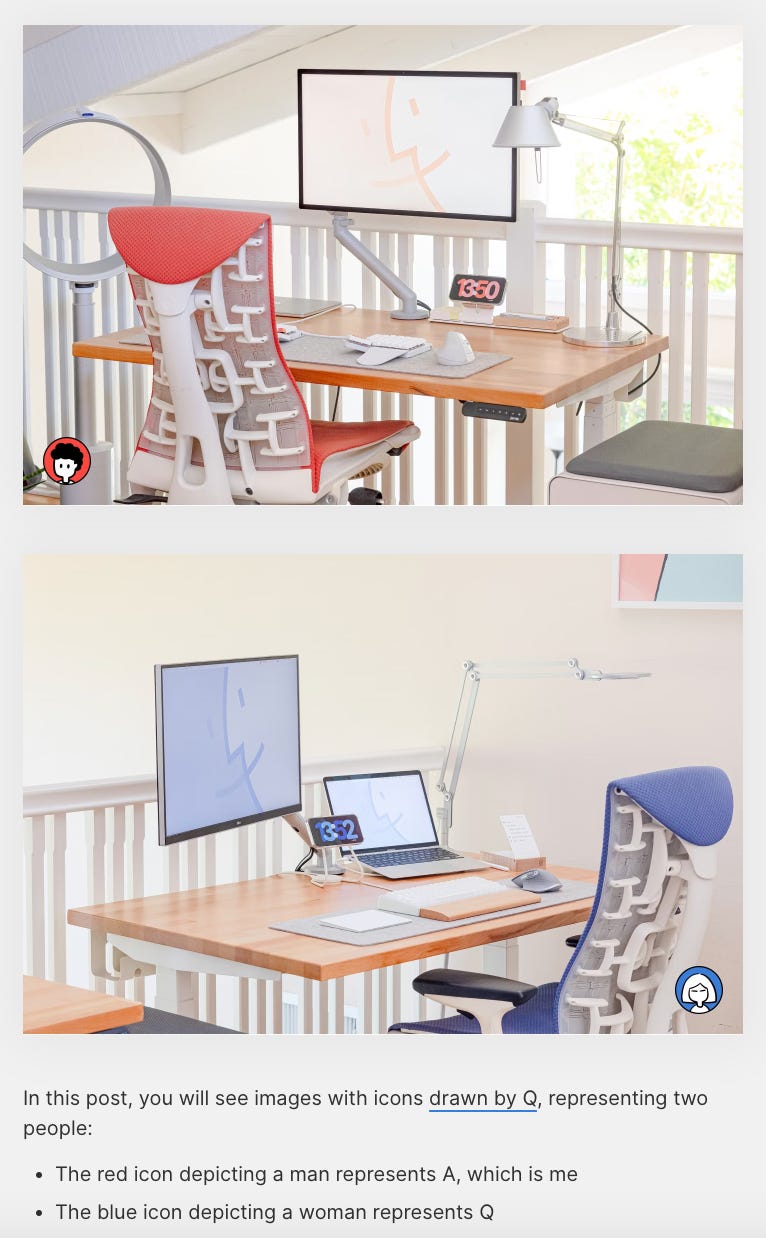
Arun Venkatesan’s “A desk setup for two” is my exhibit for ‘unreasonable care’. His setup is meticulously designed and beautifully presented, radiating attention to detail in every aspect.
The fact that he wrote about it—and in such a beautifully crafted post—shows his deep passion for his work. You might not be setting up your desk today, but give it a quick read. I was amazed by both what I saw and read. It's the stuff of dreams!
Just take a look—you won’t regret it!
🎮 Insane Engineering of the Gameboy
I never owned a Gameboy. In India, the video game journey was very different from the West. My first gaming experience was at video game parlors where we played Mario, Contra, and more. Some kids had their own consoles, which earned them plenty of respect in their circles.
Later, I got my own handheld 'brick game,' boasting 999 games in one—though we could never tell the difference between them. The batteries drained fast, so we bought our first pair of rechargeable ones.
We missed out on an iconic product: the Gameboy. Watching “The insane engineering of the Gameboy” stirred some nostalgia (the challenges were universal) and regret for missing out on such a brilliant device.
But this isn't just about nostalgia. The 18-minute video dives deep into the engineering that made the Gameboy possible. It covers memory limitations, counterfeit challenges, battery efficiency, and pricing—all factors that shaped its success. We often overlook the effort behind these innovations. Watch this video to appreciate the work that went into making the Gameboy a legend. It’s fascinating to see what happens behind the scenes!
(via Readwise)
☑️ Lessons from an Election Campaign
Will Stancil talks about his experience & lessons learned from running for office. Not a political discourse, just some glimpse of things on the ground.
When you become so familiar with the people in the district, it’s hard to escape another realization: Maybe you entered the race because you felt like you had clever views on policy. But once you get to know the people in the district better, you become more keenly aware what you’re asking of them: to be their representative.
I’m not aware if elections are run the same way in our constituency. Will’s story could be those of a minority, but it feels like the right approach.
“All politics is local,” goes the cliché. It’s wronger today than ever before. In 2024, all politics is, if anything, national. But local politics are where you can glimpse what politics used to be—before 24/7 cable news, before Trump, before social media sloganeering. Today's hyper-polarized elections are simpler, flatter, and meaner. They reduce people to numbers in a bloc, and strip away the voices of everyone in the smaller share. In these local campaigns you can still see the vestiges of a more complicated, less-certain style of democracy than we have today. Once seen, it's hard to unsee, whatever the electoral benefits of doing so.
(via Dense Discovery)
✨ Everything else
Ten tips to make a million dollars. Tyag is super funny & generous. If these don’t work, you can go back to him for more. He promised.
In this house, we believe… another good one from McSweeney’s. It’s humor done well. Great observations, and put in a way you cannot ignore.
Rocco Buttliere is a lifelong brick builder and makes detailed replicas of famous buildings with Lego. Stunning work! (via DenseDiscovery)
⏰ In case you missed last week’s post, you can find it here.

That's all for this week, folks!
I hope I've earned the privilege of your time.
If you liked this post, please hit the ❤️ below, leave a comment or share with someone who will find it useful too. It’s highly encouraging.
Thanks for the shout out! ❤️
I loved the two desk setup but I’ll be honest … what made my Monday was Tyag’s Ten tips to make a million dollars and from there “My one life advice”. Both these articles are so freaking relatable (apart from being full of humor). Please continue doing the awesome job you do with “Stay Curious”, Pritesh 👍