


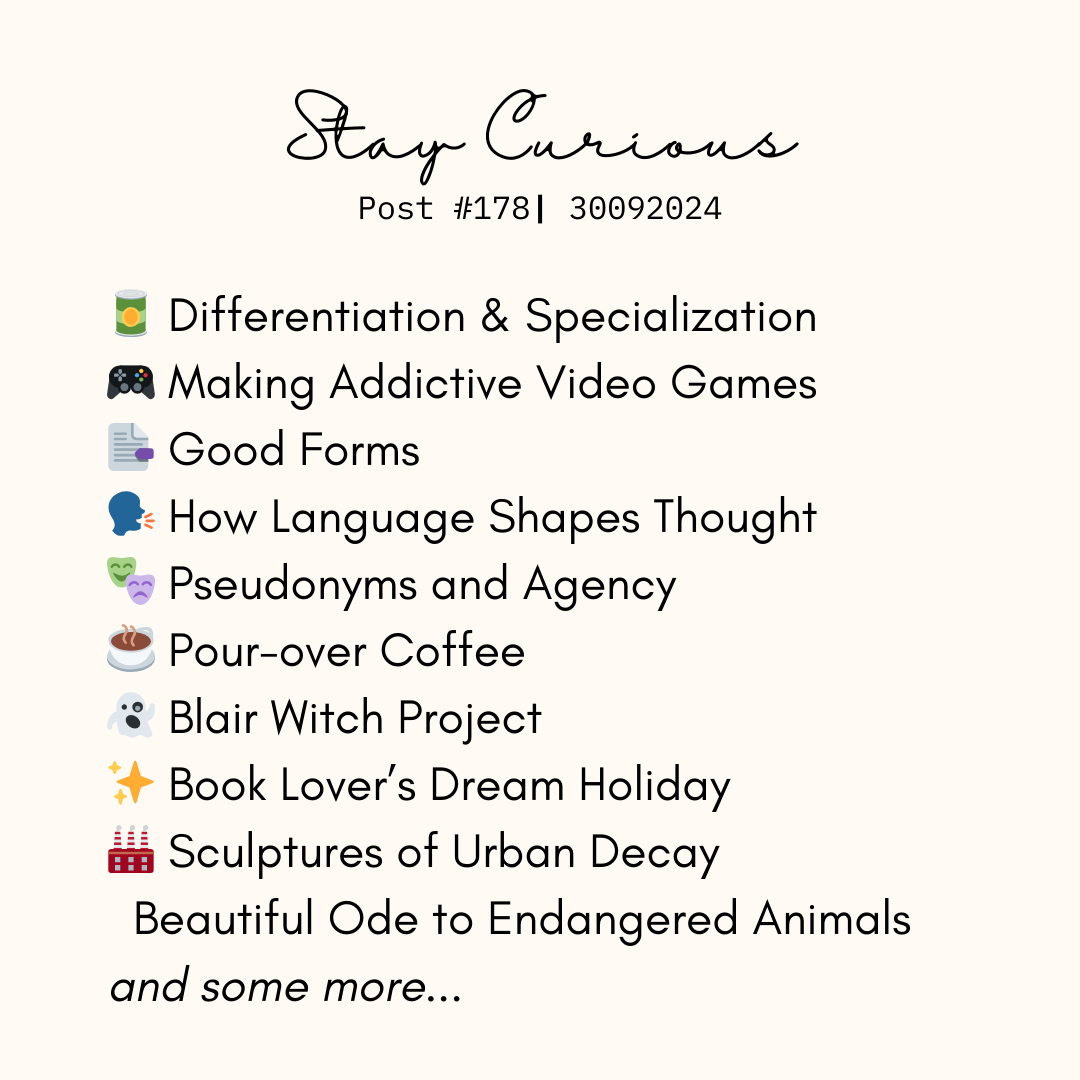
📚 Differentiation & specialization, Addictive video games, Good forms, Pour-over coffee, Blair Witch Project
How language shapes thought, Book lover’s dream holiday, Beautiful ode to endangered animals and more

Hello, this is post #178.
The festive season is almost here! October will be packed with travel—we're heading to Gurgaon, Mumbai, Pune, and home. It’s been ages since I last visited these places. I'm excited to catch up with friends and finally check off some spots on my wishlist. If you have any recommendations—food, places to visit, activities, or experiences—let me know!
Today’s lineup covers a range of topics, from video games to movie marketing. As always, I loved curating these.
Here’s a quick look:
You know what to expect. Let’s not wait and get started.
🥫 Differentiation & Specialization
Being different for different’s sake is tough. Roadside attractions pull it off, but they must have close to 100% churn. How many times can you visit the “biggest whatever…” or a museum of hammers?
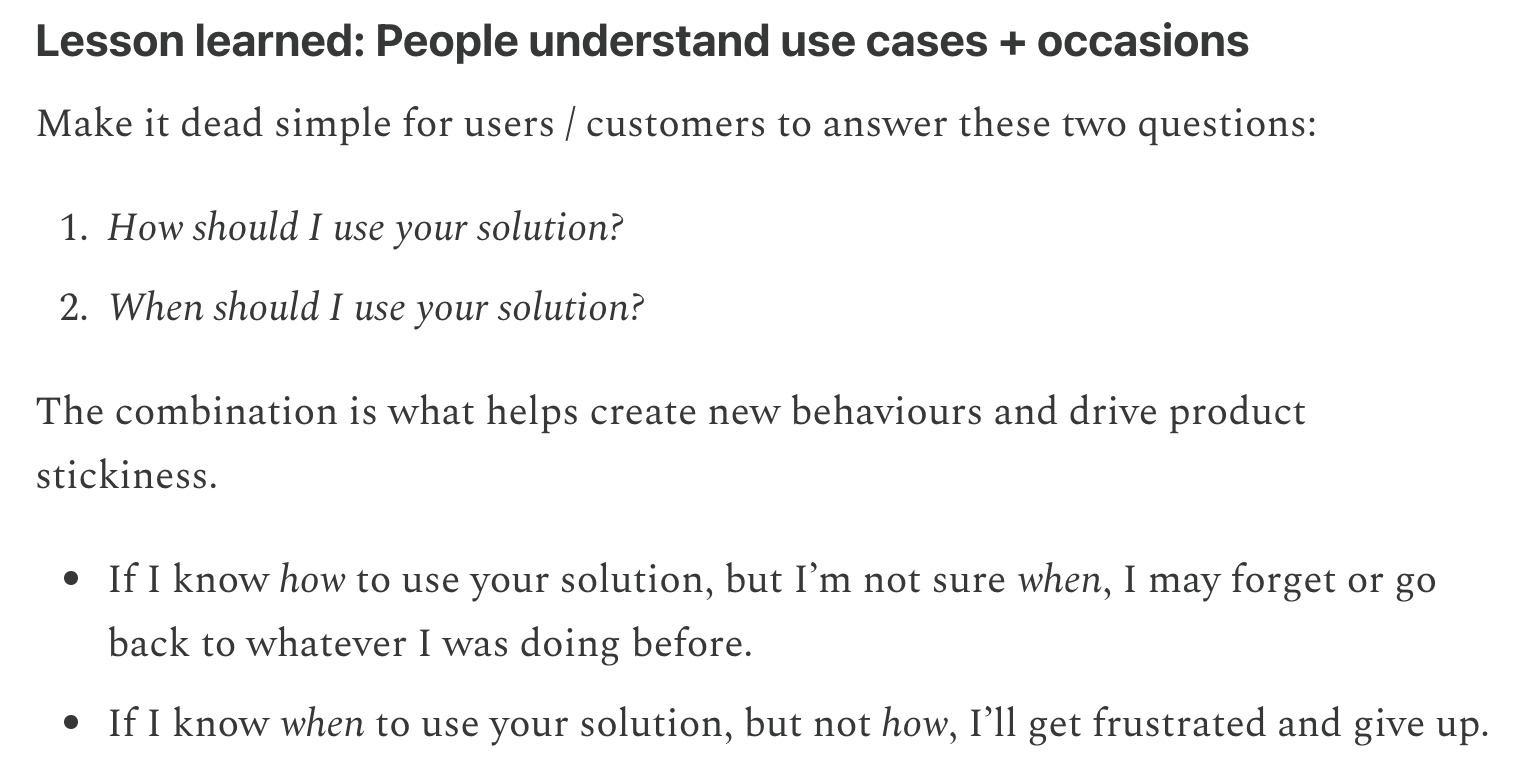
It's not enough to just be different. You also need to be:
More specific in your audience—the more targeted, the more you stand out.
More specific in your solution—focus on doing less, but better.
However, this narrows your potential market. Being specific gives you an edge, but for a smaller audience.
In “Differentiation and specialization done right”, Ben Yoskovitz shares insightful examples of this challenge and the lessons he learned. Here's the gist.
🎮 Making Addictive Video Games
If you’re interested in the gaming space (I am, you would have guessed by now), then give a listen to Search Engine Podcast’s episode “How do you make an addictive video game?”
In this episode, PJ Vogt talks to Ben Brode who is the designer behind Hearthstone and Marvel Snap. They discuss how a creative person learns to make the things they love, and about the secret ideas hiding in games as simple as rock-papers-scissors.
Yes, rock-paper-scissors!
Here are three reasons I loved this episode:
It’s packed with great insights on the creative process. My favorite bits:
How would you make it better? Anybody who makes creative work professionally, started out as someone who enjoyed that sort of thing first. Directors were kids who watched movies. That question – how would you make it better? – that’s the first door, the hardest one really, that you have to walk to go from enjoyer of to make of.
The vibe is great. You can feel the energy—Brode’s loud laughter adds to it. He is so fun!
Vogt is a great storyteller. His detours are fun and enhance the narrative without getting in the way.
📑 Good Forms
Dave Rupert shares some thoughts around “good forms”. He is sharing an engineer’s perspective on building a good product and experience. Expect a lot of objective inputs & well defined requirements. There are a couple of nerdy bits, as well. Don’t tell me I didn't warn you!
It's a quick but valuable read, highlighting simple details that create exceptional experiences. You'll be surprised how straightforward these tips are.
Good login forms work with password managers
Good forms have logical tab order
Good forms warn about costly or destructive actions
🗣️ How Language Shapes Thought
Lera Boroditsky’s “How language shapes thought” is the best academic presentation I've seen. An assistant professor of psychology, neuroscience, and symbolic systems at Stanford, she summarizes her research in this talk at the LongNow Foundation. Here's a brief overview of the key topics and ideas she covers.
Do the languages we speak shape the way we think? For example, how do we think about time? The word "time" is the most frequent noun in the English language. Time is ubiquitous yet ephemeral. It forms the very fabric of our experience, and yet it is unperceivable: we cannot see, touch, or smell time. How do our minds create this fundamental aspect of experience? Do patterns in language and culture influence how we think about time?
Do languages merely express thoughts, or do the structures in languages (without our knowledge or consent) shape the very thoughts we wish to express? Can learning new ways to talk change how you think? Is there intrinsic value in human linguistic diversity? Join us as Stanford cognitive scientist Lera Boroditsky re-invigorates this long standing debate with data from experiments done around the world, from China, to Indonesia, Israel, and Aboriginal Australia.
Prof. Boroditsky had me captivated for 100 minutes with her engaging narrative. Her countless examples made the talk fascinating and deepened the ideas she presented. Her sharp sense of humor stood out, adding fun without losing focus on the topic. I've never seen a better delivery—she's like a magician, always surprising with her next insight or example.
Brilliant talk. Don't miss it!
🎭 Pseudonyms and Agency
In “Pseudonyms lets you practice agency”, Henrik Karlsson posits how our identities act as interfaces.
Identities are interfaces. They mediate between your interiority and the outside world. Each identity provides a set of affordances—things they allow you to do. If you have access to the identity “cop,” you can do and say things that others can’t.
When you create a pseudonym, you can give yourself access to affordances that you lack—like the character I played as a kid which gave me the affordance to write in public. If you use those affordances in a way that is true to your spontaneous reactions behind the mask, you are authentic. Often more so than when playing “yourself.”
In small pseudonymous internet forums, for example, people are typically more colorful and individually distinct than in places where people use their offline identities—because they don’t have to think about their careers or what their neighbors will say about them.
He delves into the use of pseudonyms and offers historical perspectives on their role in literature. It's a timely read, given how many toxic online narratives hide behind pseudonyms. While it doesn't offer solutions, it gives useful insights on how to approach pseudonyms in creative work and social interactions.
☕ Pour-over Coffee
I'm a chai lover and not much into coffee, but after reading Nick Whitaker’s “How pour-over coffee got good,” I'm tempted to give coffee a chance. Nick’s essay dives deep into the world of pour-over coffee, covering history, geography, chemistry, technology, business, and culture. This broad approach makes it a fascinating read. He writes like a lover describing his muse—aware of the flaws, yet finding joy in them.
His words have a poetic charm that lets you feel what he feels. Here are a few snippets to give you a taste.
Coffee shops wanted to sell many different types of beans for customers to take home. As desire for single-origin coffees spread, shops would sell 10 or even 20 different coffees. With only two or three brewed coffees for sale, café goers wouldn’t be able to sample most of the offerings. And – despite the European allure of the espresso shot – a well-brewed cup of coffee is often the best way to appreciate complex, fruit-driven coffees that the coffee world was increasingly excited about. Espresso is so concentrated that it is hard to decipher the different notes and flavors. It’s a bit like why people sometimes add water to whiskey. This is why the very best coffee shops in England and Europe serve drip coffee, despite most of the Continent preferring espresso.
Neither coffee shops nor coffee enthusiasts always weigh the pros and cons of machines and hand brewing rationally. Some people – including myself – simply love the ceremony of the pour-over. Some, like Blue Bottle, seem to believe the ritual is of inherent value, no matter what a machine can do.
The ‘Works in Progress’ newsletter has become a reliable source of beautifully crafted long-form essays. These posts are timeless and a joy to read anytime. Definitely worth subscribing!
👻 Blair Witch Project
It’s been 25 years since 'The Blair Witch Project' hit the cinemas and changed the way we think about movie marketing.
Initially shot for just $35,000, “The Blair Witch Project” grossed almost $250 million, then a record for an indie film. It became a pop culture phenomenon, one that foretold the found-footage horror boom and left one uneasy question hovering over moviegoers: “Is this real?” It’s an existential riddle that looms larger than ever 25 years later, compelling us to apply that exact question to nearly every image, sound or nugget of information we encounter.
Missing posters of lead actors, a faux documentary, website, discussion boards - these were all part of an elaborate world building effort. This movie used the internet in a way that no movie marketer had imagined earlier. Moviegoers were sold a mystery, a new mythology of sorts.
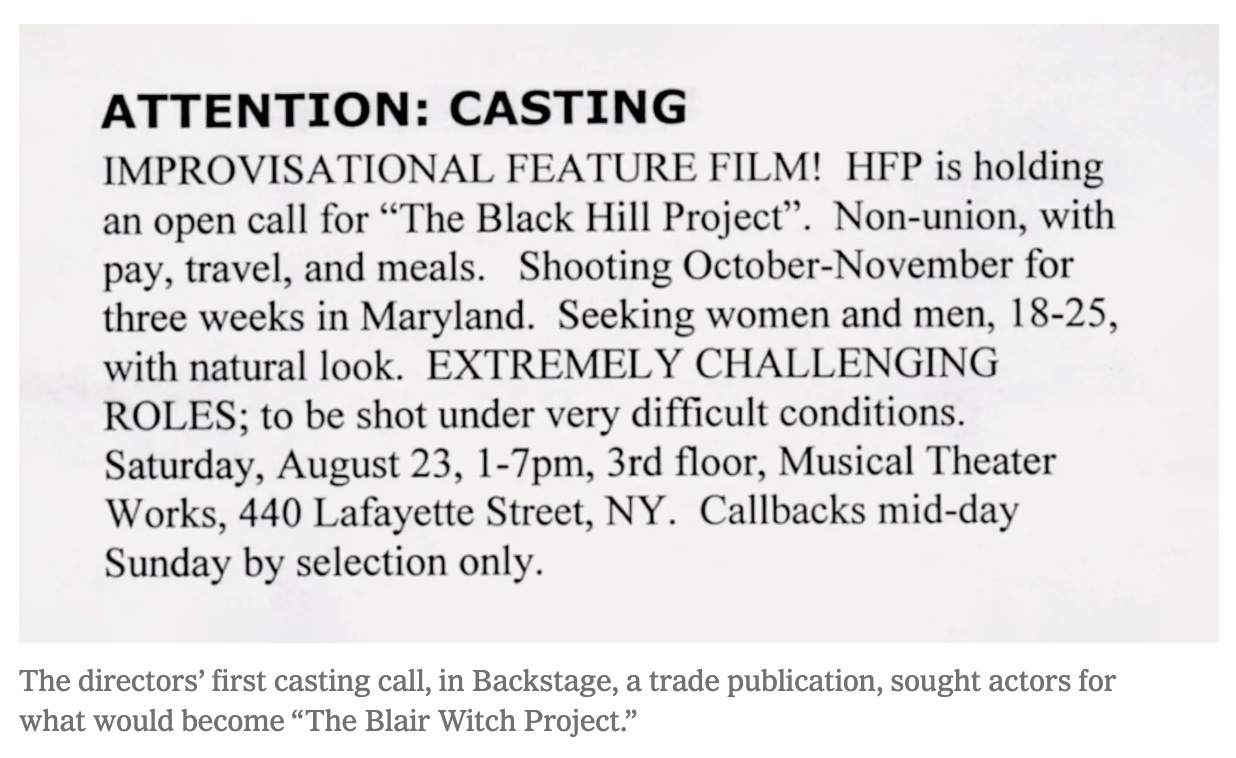
The NYTimes piece goes into a lot of fascinating details, you’re going to want to watch the movie (again). Today, when we are flooded with tonnes of ‘misinformation’, we have a ‘Blair Witch Project’ happening every moment. How will we cope?
(via Storythings newsletter)
✨ Everything else
Check out this airbnb in Scotland that is any book lover's dream holiday spot. You get to run your own bookshop. But don’t get super excited yet, it has a two year waitlist already! (via Kottke)
Australian artist Joshua Smith makes extremely detailed and realistic miniatures of grimy, graffitied buildings — he calls them “Sculptures of urban decay”. Check out his Insta feed to see him in action.
Tùng Nâm has created a stamp collection as a vivid ode to endangered animals. I so want these to adore my living room wall. Such beautiful art!
⏰ In case you missed last week’s post, you can find it here.

That's all for this week, folks!
I hope I've earned the privilege of your time.
If you liked this post, please hit the ❤️ below, leave a comment or share with someone who will find it useful too. It’s highly encouraging.
This is really insightful.