
📚 Stay Curious #250
Super Bowl Ads, Personal Brands, Falling Out of Love with Your Ideas, Generation Monologue, Peru’s Blueberries & more

Hello,
Welcome to Stay Curious #250.
I want to treat this as a personal milestone. I did not plan for it. I did not imagine it. It simply happened because I kept going week after week. That is it.
I found comfort in something Seth Godin wrote after publishing his 5000th post (he has crossed the 10000 mark already).
For me, the privilege is sharing what I notice, without the pressure of having to nail it every time… I treasure the ability to say, “this might not work.”
This milestone means the same to me. The freedom to think out loud. To experiment and put something out; something that excites me. I will be wrong many times. But that will be ok. The real win is to keep showing up. Collect the dots and then connect the dots.
A quick pause to thank everyone and everything that made this possible.
And now, back to today’s post.
One of the joys of this journey is the ability to look back and see how far we have come. So let us begin with a quick revisit to the very first post, just to taste how it all started. And then we will move to some fresh ideas that have made me think this week.
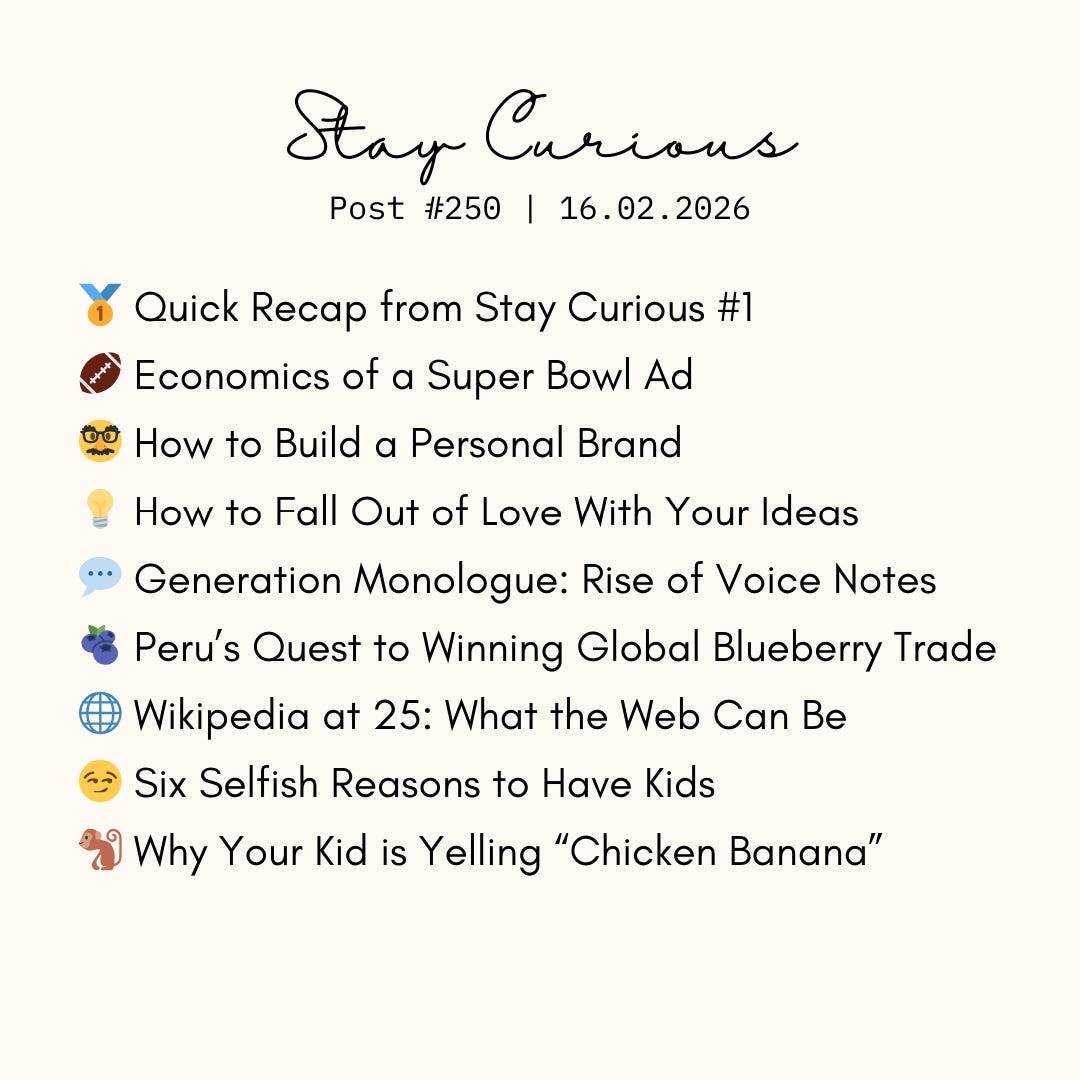
Let’s go go go …
🥇 Quick Recap from Stay Curious #1
Title: #1 Hello World!
Subtitle: One with the most stereotypical title.
Reading & reflecting on my notes have been a great source of comfort in the last few months. It’s helped me energize every day to face the challenges & take up more with a positive attitude.
Below, I’ve curated some articles & sources from the learning I captured last week. Hoping you will find them useful.
1.
Empathy is a strong trait in building long-lasting relationships. In the service industry, it differentiates good experiences from great ones. This article talks of 4 actionable insights leveraged by the content team helping co-op funeral directors in the UK.
2.
Psychology plays a very strong role in all the choices we make. This article captures some important lessons on how Peloton has used it to design their product experience and create stickiness that’s unparalleled.
The trigger-routine-reward cycle described in the habit loop framework is being considered for the coach approach. Will be very interesting to see it in work & help improve stickiness in our products & services.
3.
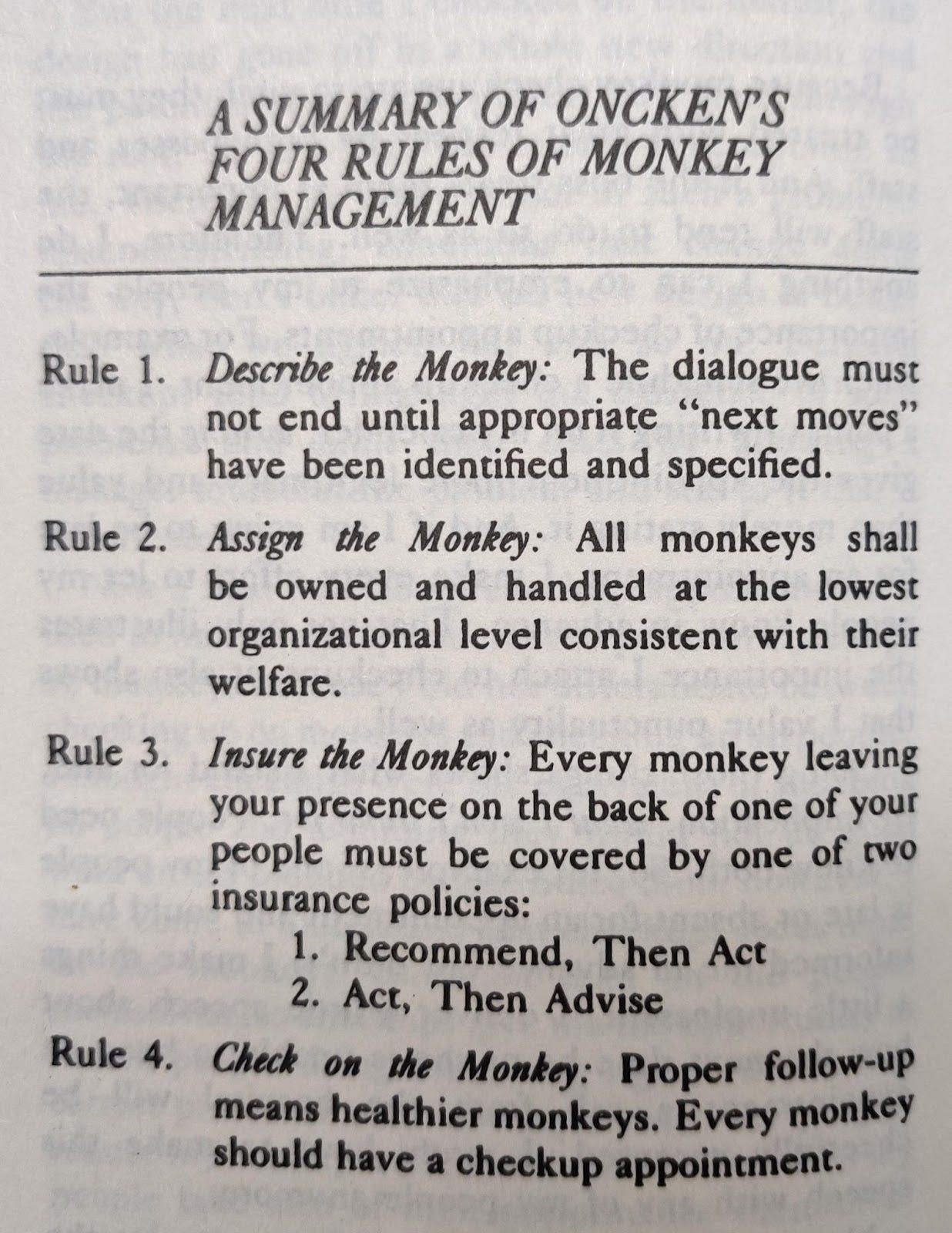
Book recommendation: One minute manager meets the monkey (amazon link)
We regularly find it difficult to manage our time effectively. Our calendars & working hours are busy. We overstretch most of the times, still are always in chasing mode. This book elaborates 4 rules on how to get out of this situation. It’s a very quick read, so go for it. Sharing a snapshot from the book covering the 4 rules in brief.
4.
Some random goodness from the internet:
Twitter: Finding hope with Dinosaurs [Does not exist anymore!]
Twitter: Finance & investing concept simplified with 10-K Diver
Instagram: Streetlights from around Japan with m_light_00
Newsletter: Now I know: One interesting story a day, covering a variety of interests & geographies
Views: 97+, Likes: 0, Comments: 0, Share: 1
Here’s a quick link to original post:

What do you think about this journey?
🏈 Economics of a Super Bowl Ad
$233,000 per second, minimum, for the air time — excluding all other costs. When you first hear that a Super Bowl ad costs at least $233,000 per second, it’s completely reasonable to pause and question whether that could ever be a good use of money. On its face, the price sounds extravagant — even irrational. And without context, it often is.
But once you break down the economics, the decision starts to look very different. The Super Bowl is not just another media buy. It is a uniquely concentrated moment where attention, scale, and cultural relevance align in a way that doesn’t exist anywhere else in the media landscape. That alone changes the calculus. This leads us down a fascinating discussion of the economics behind DTC advertising, brand building, and the production of the spot.
That is the premise and promise of Z Reitano’s long post on X.
I first discovered the hype around Super Bowl ads during my MBA days. Innu once shared how these ads are dissected and debated in her class like election predictions. That was fascinating. I have continued to keep my eyes and ears open about them ever since.
Super Bowl ads still dominate the US media landscape. Every year, some brand manages to grab attention not just from advertising and marketing folks, but from anyone who cares even a little about brand building and the evolving media world.
Reitano’s post is a thoughtful take on how to think about brand building and how to frame the ROI of such massive investments. There is no single perfect answer here. But his framing is far better than many half baked explanations I have seen or even worked through myself while thinking about brand investments.
Read: The Economics of a Super Bowl Ad
And while you are at it, here is a lighter but sharp take from one of my favorite marketers Tom Fishburne aka Marketoonist. His style of witty cartoons to make pointed commentary on all things marketing unpacks so many unspoken truths about this space.
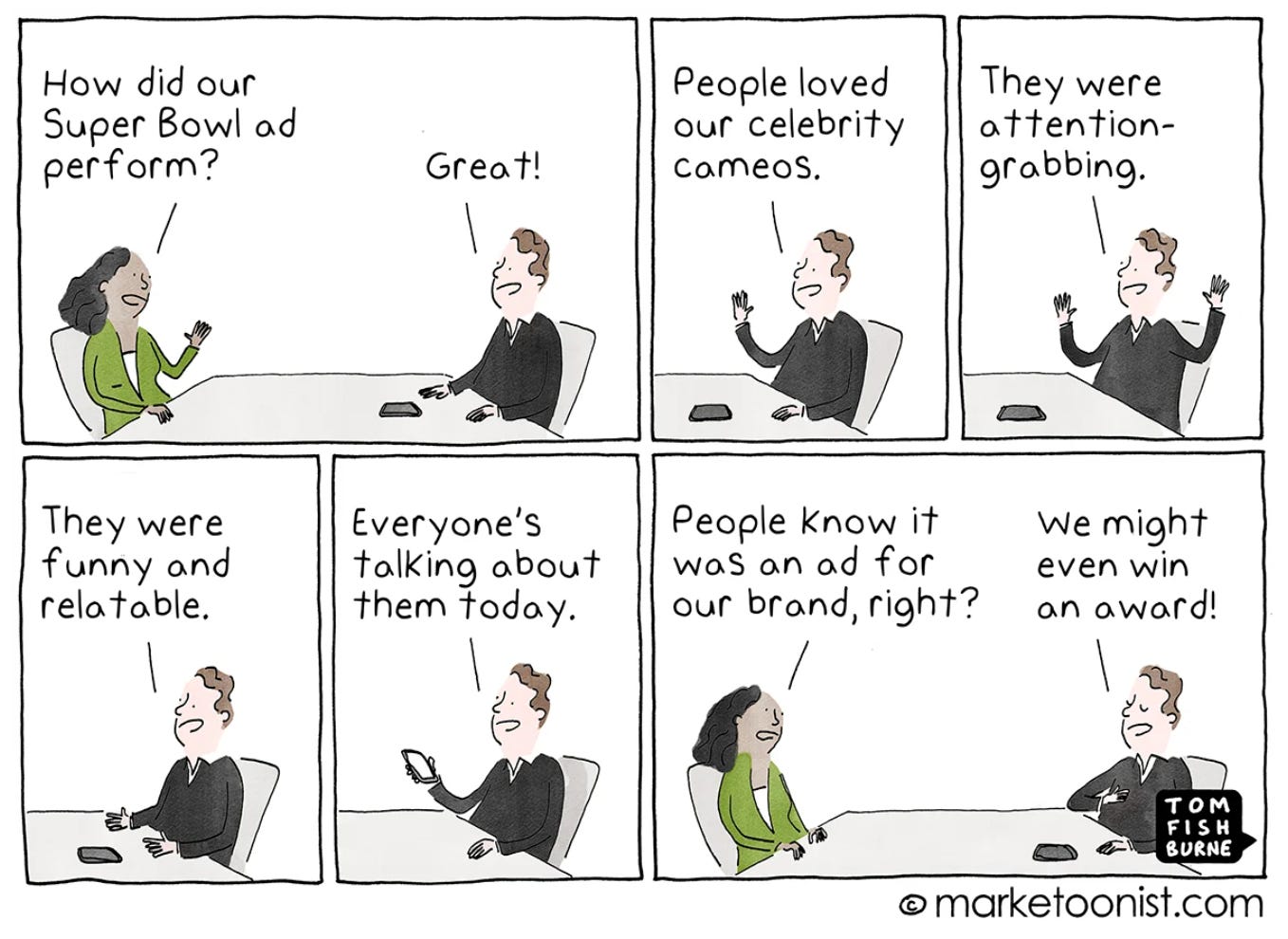
Read: Advertising, Brand Recall, and Celebrities
It is quick to consume, but offers a good second opinion on the theme.
🥸 How to Build a Personal Brand
William Meller’s Anti Self Promotion Guide to LinkedIn packs so many sharp ideas in one place that I had to share it.
I spend a fair bit of time on LinkedIn. I post every few days. And yet, I often fall short of the goals I set for myself there. This guide quietly answers many of those doubts.
The playbook does read a bit like it was structured by an LLM. But beneath that structure, the ideas are sharp and relevant. It highlighted gaps I have already sensed in my own work, which made it instantly relatable.
You can explore and pick a few pieces to test. That is exactly what I plan to do.
Read: How to Build a Personal Brand
💡 How to Fall Out of Love With Your Ideas
People hear “intellectual humility” and they imagine backing away from strong opinions, like it’s some sort of weakness. In reality, intellectual humility is a skill. It’s the ability to say: I believe this. I might be wrong. I’m willing to find out.
The hard part is doing that when the idea is yours, you’ve already pictured it working, and you’ve maybe even congratulated yourself.
One of my biggest lessons from working with Vikas in my previous stint was his insistence on not falling in love with an idea. He would push us to form strong opinions. But he would also nudge us to change them when the facts did not support them. That balance is hard.
Our ego made it tougher. We added one more argument, and blamed external factors. Almost always, we convinced ourselves the idea was right, the world was wrong.
This remains an area of improvement for me. And I know that getting better at this will increase my impact on anything I work on.
Laura Huang’s short piece brought this lesson back to the surface. She offers a few practical suggestions on how to detach from ideas without losing conviction.
Read: How to Fall Out of Love With Your Ideas
This is not a small skill. Often, it is the difference between building something that lasts and failing quietly. I am grateful to Vikas for drilling this into us everytime.
[via FoundingFuel]
💬 Generation Monologue: The Rise of Voice Notes
I first noticed voice notes during my sourcing trips to China a decade ago. Everyone seemed glued to their phones. They were not just watching their screen, but talking and listening. It was a lot of short bursts, almost like how walkie talkies feel.
It was obvious that speech can carry information and emotion much faster than typing. Still, I never fully switched. Texting works for me. Calls fill the gaps when needed.
Later, I saw friends use voice notes to communicate with drivers or household staff. The barrier was not language. It was reading and writing. Voice solved that neatly.
Then came Covid. And the global rise of voice based content. Suddenly, voice notes were everywhere, at least globally.
Helen Coffey’s piece explores this shift and what it means for how we relate to each other.
Therein lies the problem. Unlike a phone call or face-to-face catch-up, voice notes are very much not a conversation. They are a one-way form of communication – a soliloquy into the void, a one-(wo)man show in which the sender plays the starring role. There is no place for the recipient to interject, react or respond in real time. Call it broadcasting, rather than conversing. It’s no wonder that 76 per cent of people say voice notes tend to be “self-involved”.
Read: Generation Monologue: How the voice note killed the art of conversation
I may not have fully transitioned. The younger generations clearly have. I suspect even our parents will get comfortable once they get past the initial friction.
Utility will push us toward voice. But I hope we also think about the emotional texture of communication. I hope the technology will find a middle path somewhere.
[via After School by Casey Lewis]
🫐 Peru’s Quest to Conquering Global Blueberry Market
Peru was not a serious blueberry producer two decades ago. Today, it plays a critical role in supplying the fruit to the world, especially when traditional growing regions are out of season and global demand keeps rising.
Rishi Pethe’s piece explains how this shift happened.
It started with spotting a sharp opportunity. There was a supply gap during the off season. Peru took up the challenge to solve this one gap. And it went all out to make it happen: deep investment, new blueberry variants, smarter farming practices, better irrigation, infrastructure upgrades, policy support, financial incentives. A coordinated push across the system. Some of it was in works for over a century, some happened in just two decades. Overall, things worked out fairly well and now Peru has a meaningful role to play in this business.
It is a great example of how a country can carve out a niche by aligning strategy, execution, and timing.
Read: Chasing Counter Seasonality
The piece gives a good overview of how this business works. Not too technical. Not too shallow. Just enough depth to satisfy your curiosity without overwhelming you.
If you love fruits and are curious about their history and cultural impact, you should read the Works in Progress piece on pineapple - King of fruits.
History, trade, politics, symbolism, technology, economics - all packed into one story. This is the kind of storytelling that makes you more interested in a field than you were before you started reading.
[via MR Blog]
🌐 Wikipedia at 25: What the Web Can Be
Ever since I began using the internet, two things have stayed constant. Email. And Wikipedia.
Wikipedia, especially, has played a huge role in my learning. My usage has dipped in recent years. But every time I return, I walk away impressed and wondering why I do not use it more often.
Part of that is on me. Part of it is the environment the rest of the internet has created. Big tech and media have reshaped, even forced, how we discover and consume knowledge.
Anil Dash explored this in a recent essay. It is one of those ‘good to know’ pieces. The kind that explains something that quietly shapes your life, even though you rarely stop to think about how it exists.
Read: Wikipedia at 25: What the Web Can Be
The site is still amongst the most popular sites on the web, bigger than almost every commercial website or app that has ever existed. There’s never been a single ad promoting it. It has unlocked trillions of dollars in value for the business world, and unmeasurable educational value for multiple generations of children. Did you know that for many, many topics, you can change your language from English to Simple English and get an easier-to-understand version of an article that can often help explain a concept in much more approachable terms? Wikipedia has a travel guide! A dictionary! A collection of textbooks and cookbooks! Here are all the species! It’s unimaginably deep.
✨ Little Moments of Joy
Also known as “Everything else…”. The small things that brought warmth, sparked joy, and made me appreciate life a little more.
Kevin Kelly shares six selfish reasons to have kids. This one is so true and most felt.
There is a profound and primeval joy in helping a helpless infant become a functioning adult. It is very clear they cannot do this on their own, so the role of teacher, trainer, coach, parent is essential and this need is felt deep. The singular bond that arises from this dependency also entails worry, as well as joy, but for most parents the joy outweighs the worry. But for a long while, they depend on you, and if you provide, the rewards of giving, of helping, are poured upon you.
And while you are thinking about kids, whether you are raising them or just observing them, here is a small warning. You are going to hear things that make no sense. Not the classic baby talk like “Gugu Gaga”, but phrases like “six seven” or “chicken banana.” This is the new Gen Alpha slang. Our younger ones may not officially be on the internet yet. But the internet has already reached them and shaped their language and interaction. Anna North unpacks this strange new world in Why your kid is yelling “chicken banana.”
“Children are a marginalized demographic and are denied autonomy in so many aspects of their lives, in favor of what their parents want for them,” Colangelo said this week. “As children come into their own personalities, they become desperate for anything that feels ‘theirs.’”
If adults are befuddled or even mad, that’s part of the point. “Their goal is, honestly, just to confuse older people, and they wear that as a badge of honor,” Dannenbring said. “It’s like their own language.”
ICYMI, here is the link to last week’s post:

That’s all for this week, folks!
I hope I’ve earned the privilege of your time.
See you next Monday.
About voice notes, I am not a big fan (yet) despite the convenience. My angst is around the listenability or lack of it in public places.
Congratulations on #250 Pritesh. What a milestone!