
📚 Side Projects, Hacker Culture, Flexport Story, Arc of Collaboration, Communication is The Job
Where is My Train, Hiring Great Anything, Street Art, Weird Buildings, Dicing an Onion & more

Hello, this is post #224.
I picked up a new earworm: PASSO BEM SOLTO by ATLXS. An 11-year-old introduced me to it, we played it a couple of times, and I was hooked. My kids and Instagram reels - those are my two main sources for discovering new music. They lean toward a certain music type, so I know I’m missing a lot that’s out there.
Radio doesn’t work for me. The ads, the chatter, and even the curation feel off. Maybe it’s the commercial channels here, or maybe I’m just too critical.
My favorite playlists, though, are built on songs I picked up back in college. Only a handful of tracks get added every year now, each one carrying a story I still remember. Maybe I should write those stories down. The songs will stay, but the memories might fade.
Now I’m wondering, how do I add more variety to my music? Feels too early to settle into just a few artists and albums.
My favorite playlists are filled with songs I picked up in college and still play today. Most of them carry a story I remember vividly. Maybe I should write those stories down. The songs will last, but the memories might fade.
Only a handful of new tracks make it into these playlists each year. How do I add more variety to my music choices? It feels too early to settle for just a few artists and albums.
While I groove to Passo Bem Solto (again), you can dive into what I’ve lined up today.
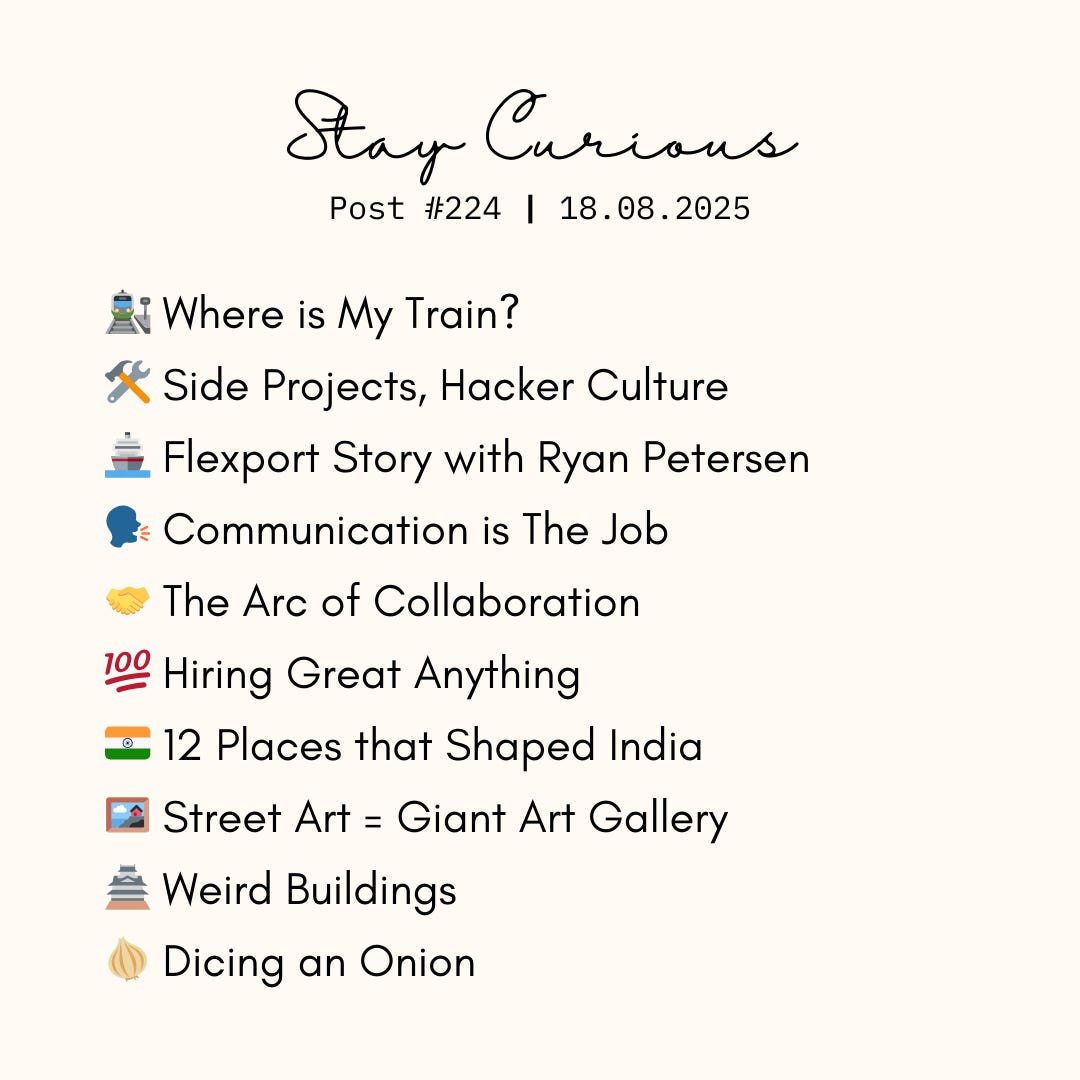
Looks exciting, right? So why waste another second? Let’s go!
🚉 Where is My Train?
When I was working on growing our Ludo business, I stumbled on something new. A big part of our user base had been active on apps I had never used: “Where is My Train” topped that list. Along with it came a bundle of utility apps—Xender, file sharing tools, image and photo editors, YouTube video downloaders, and more. Millions in India were downloading and using these.
I could see the need, but I didn’t fully get how they had reached such massive distribution and daily use. “Where is My Train” especially stood out. It solved a problem that had nothing to do with entertainment or self-expression, yet it was everywhere.
So when
published a deep dive on the app’s journey and an interview with its creator Nizam, I had to read it. And I’m glad I did. The story is fascinating: a product built on a sharp user insight, crafted in true jugaad style.Here are a couple of anecdotes I loved:
We noticed many reviews mention "TTE recommended it." This makes sense when comparing train and food delivery apps. With Swiggy, you only share when you're excited about good food. But train travel is different. If you're wondering where your stop is, you'll ask another passenger. When they open Where Is My Train to answer you, you naturally ask about the app. People are idle on trains and check their location frequently. That's why we kept the distinctive blue color - when you see others using it, you build trust in the app.
I often arrive early at train stations to check our platform board information. People frequently ask me for help understanding the displays. In one interesting encounter I recommended "Where Is My Train" app to a passenger. He asked me to send the "software" to him, then said "Xender it" - referring to Xender. When I tried to help him download it from Play Store, I discovered he didn't even have a Google account. It's extremely difficult to build good products without understanding your users.
🛠️ Side Projects, Hacker Culture
I enjoyed listening to Kailash Nadh’s conversation with Arnav Gupta on the Scaler podcast. They dive into side projects, hacker culture, and scaling with sense.
Kailash’s story about building dns.toys and why he made it is a gem. Arnav’s sharetime story is just as fascinating, showing how side projects can fuel endless learning and curiosity.
Both of them are at home in that space: thinking simple, building clean, and avoiding jargon. Kailash is inspiring. His ideas stretch from the small joys of everyday life to the bigger ripple effects of our actions. And Arnav does a great job of drawing both sides out without turning it into an intellectual sparring match.
If you like Kailash Nadh’s ideas, here’re a couple more from Stay Curious archives: user disengagement and web3/web2 debate.
🚢 Flexport Story with Ryan Petersen
Ryan Petersen’s chat with Shane Parrish is my next reco for today. They cover his journey of building Flexport, lessons from Y Combinator, and his takes on tariffs, quality, and culture. Ryan is both a storyteller and a thinker, and I love people who can do both.
From the iPhone leak story to their discussion of Peter Kaufman’s ideas, this one is packed with gems.
Here are a couple of key takeaways (lifted from Shane’s blog on the podcast):
3. Obsession Is the Advantage: “I can’t stop thinking about Flexport,” Ryan admits. It consumes him—infinite problems, daily variety, global complexity. While others burn out, his obsession sustains decades of grinding. Work that captures your mind beats work that pays your bills.
4. Quality Costs Less: In logistics, a single mistake erases months of efficiency gains. One wrong customs code triggers weeks of fixes. Ryan’s teams now prioritize accuracy over speed. In complex systems, doing it right once beats doing it fast twice.
10. Choose Your Constraint: “If a bottleneck appears where you didn’t choose it, you’re not running the operation, it’s running you.” During COVID, surprise bottlenecks erupted everywhere. Ryan lost control. Now he designs constraints intentionally, ideally at customer demand. Control where work slows down or it controls you.
🗣️ Communication is The Job
In 15 years of building products and teams, one thing has stayed constant: the need to communicate. The mode and message keep evolving, but the importance only grows. Facts now make room for stories. Insights walk alongside dreams.
We spend so much time on functional skills, debating and reviewing progress, yet communication rarely makes it into the leadership curriculum. I learned it on the job—by watching those who did it well, by working with leaders who pushed us to get better, and by reading those who called it the ultimate superpower.
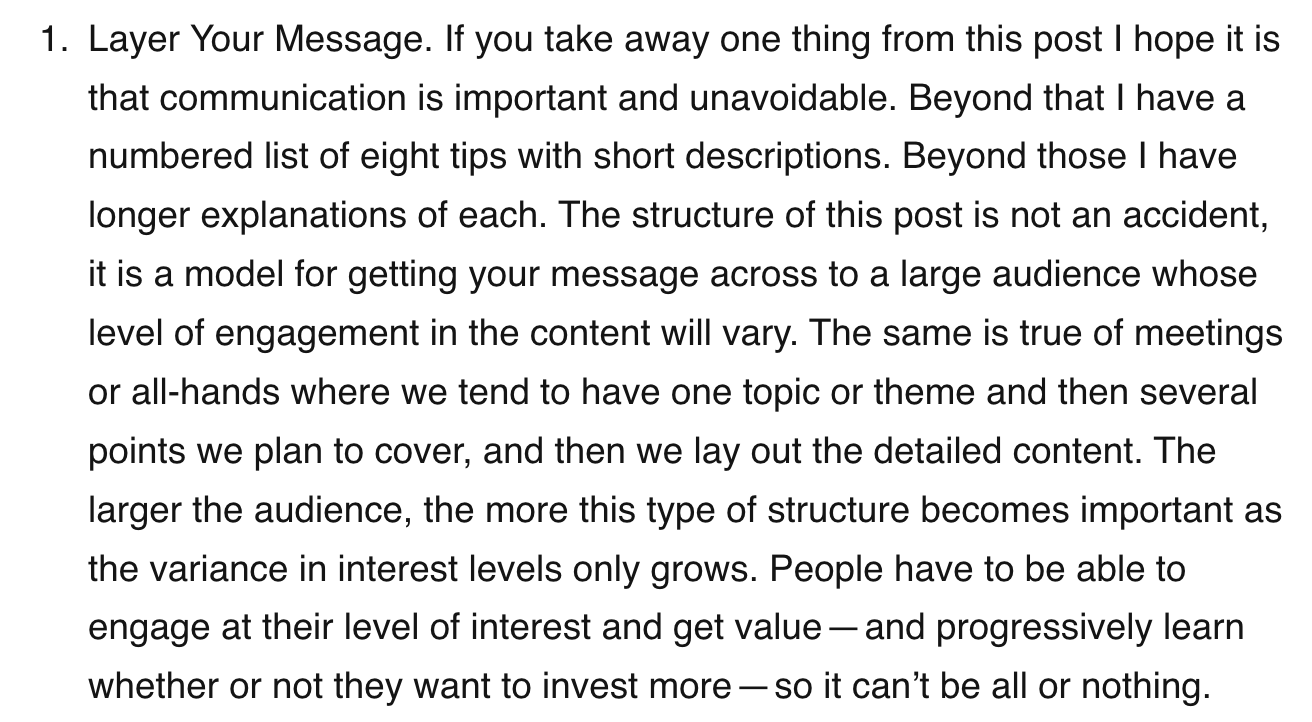
Here’s a reminder for me and every leader: Communication is The Job. This time, the voice is Andrew Bosworth (Boz). He shares 8 sharp tips, each one worth taking note of. I’ll leave you with the first, which is itself a masterclass in “show, don’t tell.”
🤝 The Arc of Collaboration
As the ecosystem of specialized SaaS apps and workflows continues to mature, messaging becomes a place of last resort. When things are running smoothly, work happens in the apps built to produce them. And collaboration happens within them. Going to slack is increasingly a channel of last resort, for when there’s no established workflow of what to do. And as these functional apps evolve, there are fewer and fewer exceptions that need Slack. In fact, a sign of a maturing company is one that progressively removes the need to use Slack for more and more situations.
Kevin Kwok posited in The Arc of Collaboration that there is no distinction between productivity and collaboration.
Productivity and Collaboration are two sides of the same coin for any team with more than one person. Work is just the iterated output of individuals creating and coordinating together.
But the two have been distinct and isolated segments historically, due to how long the feedback loops of both were.
This post is from 2019, which feels like ages ago given how fast technology and work tools have evolved. It leans on the experience of Slack, Dropbox, Google Docs, and Figma. Many of those ideas have since matured and even shaped the foundation of today’s tools.
What I liked most is how it breaks work into two core aspects: productivity and coordination. It strips the problem to its basics, then builds the complex solution back up.
Worth revisiting every now and then, just to stay grounded in the fundamentals.
💯 Hiring Great Anything
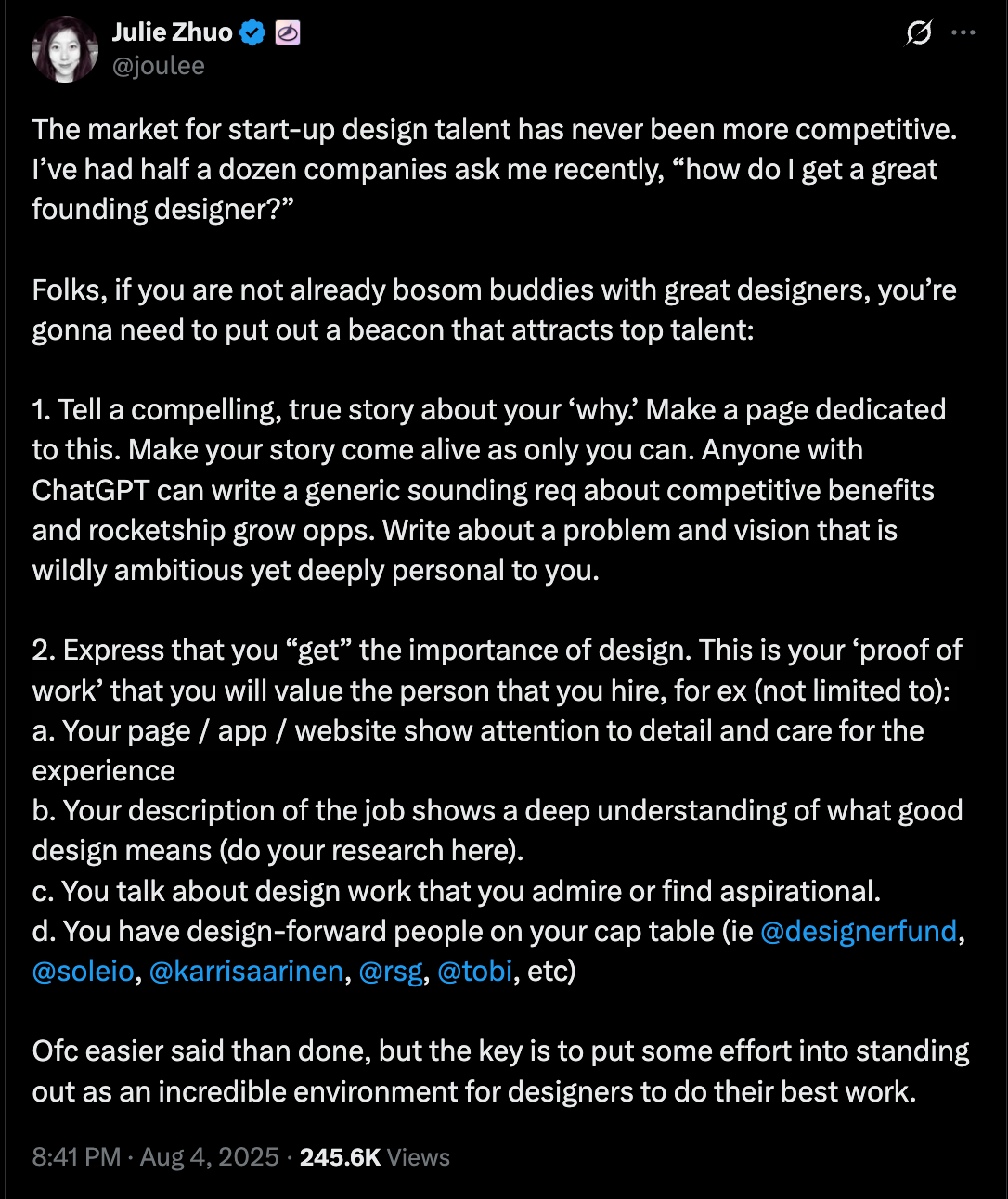
This post from
is worth pausing on. She talks about design talent, but I think it applies to any field where the best people are driven by passion and care deeply about their craft.For a founder or leader, doing these two steps is no small effort. It quickly shows if you and your environment are truly ready to hire and nurture that kind of talent and culture. A neat self-test, if you ask me.
🇮🇳 12 Places That Helped Shape Post-Independence India
To mark Independence Day, the Founding Fuel editorial team pulled together a special feature: 12 Places That Helped Shape Post-Independence India. Each place is told as a story of history, culture, and impact. Here’s the list for your reference:
Connemara Library, Chennai: A City’s Bookkeeper
Sriharikota, Andhra Pradesh: From Makeshift Bridges to Mars
MS Swaminathan Research Foundation: Where Ideas Take Root
The Indian Coffee House: The House That Workers Built
Bylakuppe, Karnataka: Where Refuge Transformed into Rebirth
Indian Institute of Advanced Study, Shimla: A Historic Seat of Power and Academic Research
La Martiniere College Lucknow: A Living Restoration
Living and Learning Design Centre, Kutch: A Sanctuary of Stitches
Turtuk, Ladakh: India’s Balti Frontier at the Edge of Siachen
Birsa Munda International Hockey Stadium, Odisha: The New Cathedral of Indian Hockey
National Defence Academy, Khadakwasla, Pune: The Long March to Equality — NDA’s First Women Cadets Join the Parade
Udupi: From Temple Kitchens to City Streets: Shaping India's Dining Culture
Surprising, right? I hadn’t heard of most of these. But as I read, each one felt like it belonged on the list. These stories rarely enter our everyday conversations. I wonder what it will take to change that.
✨ Everything else
Street art turned my town into a giant art gallery, and I couldn't be happier. I’d love to live in a place like that. Indore feels like the closest chance right now. I wish Bangalore could do the same. Yes, a few blocks celebrate art, but the rest of it is just to cover old garbage spots, not to spark a bigger city-wide movement.
Weird Buildings is a book that celebrates architects who think way outside the box. Wild, whimsical stuff. Calling it “weird” almost feels unfair to their passion. There’s even a building from Hyderabad in there, which made me both surprised and proud.
And if you want to get nerdy, check out Dicing an Onion, the Mathematically Optimal Way. The Pudding delivers this one at God level. The idea, the storytelling, even the font—it’s all perfect.
ICYMI,
Pete Koomen’s “AI Horseless Carriages”, Tomas Pueyo‘s “How Bread vs Rice Molded History” and Bharath M’s Stations are my favorite pieces from last week’s post. Here’s a link in case you have not explored it yet.

That's all for this week, folks!
I hope I've earned the privilege of your time.
Did this spark a thought, a memory, or even a question? Drop it in the comments—I’d love to hear how it connects with you. And if someone in your circle loves chasing ideas, share this with them. Curiosity spreads best when it travels together.
Loved all the nuggets in this week's newsletter - as always - Pritesh. Keep them coming. Three that stood out:
1. Music and Playlists: I have the same experience. Very hard for me to get a new song into my playlist. I am just very comfortable with the playlist I created centuries ago :-)
2. The piece on communication: Absolutely hit home. We sometimes tend to under-communicate for whatever reasons and that hurts (in both a professional and personal setting).
3. Onions: I only wish the author had demonstrated via a video or two all that he described in the article. For someone that finds math challenging, but mise-en-place of cooking very interesting, I would have loved to see it in action :-)