
📚 ChatGPT as Personalized Tutor, AI Horseless Carriages, Bread vs Rice, Good Quests, On Agency
Innovation and Not Knowing, Stations, 250 Years of Delivering, Seven Days At The Bin Store

Hello, this is post #223.
I tried my hands at two new things this week: Pickleball and Uno No Mercy. Unless you’ve been living under a rock, you already know all about pickleball and the kind of story I could paddle your way. So I’ll skip that.
Instead, let’s talk about this new Uno variant. It’s wild with twists and turns. New power and action cards make it feel like the game’s goal has shifted from finishing your cards to knocking out your competitors. There’s action almost every three or four cards. Swaps can flip the balance in an instant. Strategy is trickier now, but the game is still easy to play and loads of fun without overthinking. Just ask my 6-year-old, who won the first couple of matches and was hooked right after.
It’s exciting to see how they’ve kept an old classic relevant. The game feels faster and brings more drama. Even their Instagram leans into drama and the act of playing, not just the game itself. That’s hard to pull off, but they seem to have nailed it.
Card games have become our go-to for any gathering. They’re always fun, no matter the group. For now, we stick to easy games so the kids can join in, but I’m keen to try more challenging ones. Got any recommendations?
That’s enough of random musings. Let’s dig into the ideas, stories, and rabbit holes I’ve lined up for you.
Looks exciting, right? So why waste another second? Let’s go go go!
👍 Bret Taylor on ChatGPT as Personalized Tutor, Exams & more
In his podcast with Lenny, Bret Taylor shared how his kids use ChatGPT as a personalized tutor.
My kids use ChatGPT to quiz them before a test. You can use audio or chat mode—it’s better than cue cards. My daughter brought home a Shakespeare book, took a picture of a page she didn’t understand, and ChatGPT explained it way better than I could. Every child now has access to a tutor that can teach them in the way they best learn—visually, through audio, or by reading.
These kinds of examples come up often, but I hadn’t really tried them until now. Yesterday, I used ChatGPT to help my elder one understand a Hindi poem. It worked surprisingly well. Much better than I could have explained it. That felt like a real win. Now the challenge (at least for me) is to help her start using it this way on her own.
Of course, the other common conversation around ChatGPT in academics is about cheating or using it to do homework. That’s a fair concern, but not a new one. Bret compared it to the arrival of calculators in schools. When they first showed up, tests had to change. You couldn’t just ask questions where having a calculator gave you an edge. The system had to evolve to test understanding, not just number crunching.
He believes we’re in the same phase with AI. Schools and teachers aren’t fully ready for a world where every student carries “super intelligence” in their pocket. If you ask for a book report, AI can write it for you. That breaks the old way of doing things. But like with calculators, we’ll adapt. The transition will be messy, but necessary.
I love this mindset. It’s about staying focused on the real job to be done, and letting tools evolve as the context shifts.
Overall, a great episode. Worth your time.
🛻 AI Horseless Carriages
Pete Koomen compares today’s AI apps to the horseless carriage.
I am beginning to suspect that these apps are the "horseless carriages" of the AI era. They're bad because they mimic old ways of building software that unnecessarily constrain the AI models they're built with.
To make his point, he uses Gmail’s AI assistant as an example. He walks through a workflow that shows exactly where it falls short.
My own experience with Gmail’s AI and other Google Workspace tools has been similar. They rarely sound like me. Even after edits, the draft feels far from what I’d write on my own.
Pete explains why: it’s in how current apps use System and User prompts. My own solutions have moved in the same direction as his suggestions, though in a more basic form.
A useful read. It gave me a clearer way to think about LLMs and how to get better at working with them.
🌾 How Bread vs Rice Molded History
Tomas Pueyo‘s How Bread vs Rice Molded History is a great example of how human society has been shaped by a complex mix of factors — geology, weather, cultural norms, and more. What’s fascinating is how these forces interact with each other.
The cultivation of rice and wheat has left deep marks on the regions and societies that embraced them. Pueyo highlights striking effects on politics, culture, and the economy. Here’s a quick glimpse from his discussion on the economic impact:
Outside of harvest and planting, wheat farmers had more off-season time. This free time could be spent on other pursuits: tending livestock (common in wheat regions, since dryland grain and pasture were complementary), crafting tools or goods, or engaging in trade and markets during the winter off-season.
More importantly, wheat areas might have accelerated the Industrial Revolution and influenced the wealth of countries today.
What a fascinating read!
🎯 Choose Good Quests
Where do you choose to dedicate your life?
Trae Stephens and Markie Wagner urge us to choose good quests.
In the most simple terms possible: a good quest makes the future better than our world today, while a bad quest doesn’t improve the world much at all, or even makes it worse.
They’re clear about the kind of problems they want top talent chasing — the ones that matter. Big, tough, risky problems that need time and serious resources. Somebody has to take them on. It’s hard to argue with that.
We’ve had a similar call in the Indian startup world recently. The debate pulled in a lot of voices and opinions. There’s no single truth here.
When I think of my favorite quests, there’s always one thing in common: joy. I’ve made the biggest impact when I’ve enjoyed the work.
So here’s my take: ice cream or otherwise, more people should build things that make life better, create jobs, and spread joy.
Thanks Muskan for sharing this.
✨ On Agency
Henrik and Johanna Karlsson’s On agency has been one of the most shared essays in my corner of the internet lately. I usually skip whatever’s trending, but this one is worth making an exception for.
Like “taste,” the idea of “agency” shows up in many thoughtful conversations; and rightly so. It sits at the heart of how we act, if not who we are, and it shapes the kind of impact we can create.
One part that stood out to me is how often we confuse our ultimate goals — our raison d’être. That confusion can become a major roadblock, keeping us from building the agency we need to chase those goals with everything we’ve got.
Why didn’t I see that it would be easy to fund essay writing in this way? It was, as I’ve said, partly a lack of imagination, partly a fear of looking stupid. But it was also that my thinking was bundled. I had conflated “being a writer” with “having a publisher” and “getting a salary from my writing.” These are not the same thing.
💭 Innovation and Not Knowing
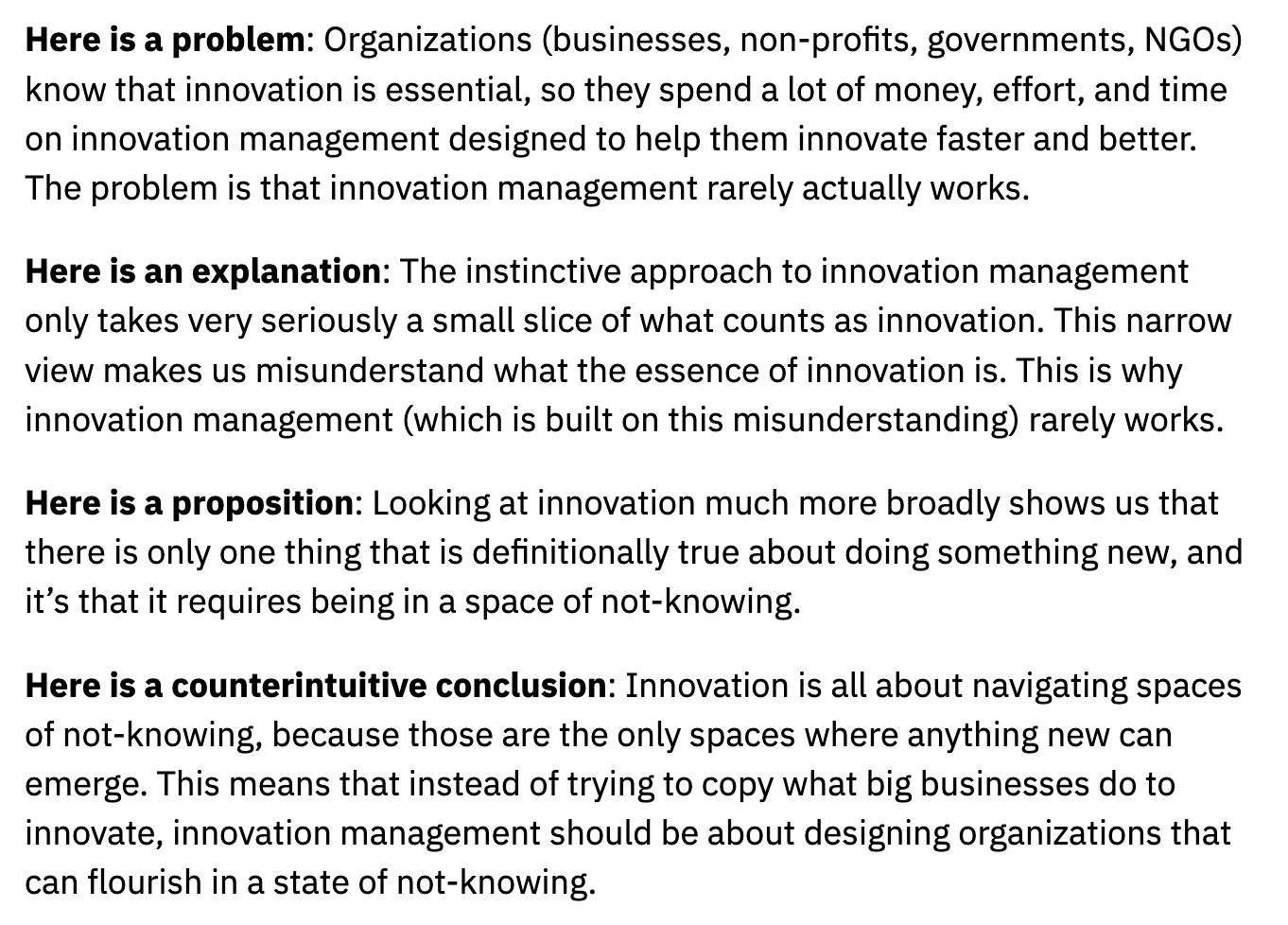
Vaughn Tan unpacks these ideas in Innovation and not-knowing. His series on “not-knowing” is a great read when you want to chew on fresh ways of thinking about knowledge, or the lack of it, and how you put it to use.
✨ Everything else
Seven Days At The Bin Store. You may not know what a bin store is, so here’s a quick intro.
But the great innovation of Amazing Binz is its pricing structure, which is splashed across the facade in Spanish and English and makes good on the promise of CRAZY DEALS. On Fridays, when the bins are freshly stocked, everything costs $10. On Saturdays, $8. Sundays: $6. Mondays: $4. Tuesdays: $2. Wednesdays: $1. Thursday is bin store Sabbath, when the shop is closed and restocked.
Chris Ware Illustrates a Postwoman's Day to Celebrate 250 Years of USPS. I want this!
Bharath M loves trains, and it shows. His passion comes through in beautiful stories (there’s an ebook and a website) and a photo collection that captures everything about trains. Check out Stations to see Indian railway stations through his eyes.
I spend a lot of time in railway stations. They are places where I go to reclaim solitude, to make sense of the world, to gaze into nothing and into everything. They are places I go to see and to be seen. They are places I go to read. They are places I go to laugh and to cry. They are places to hear stories and tell them. They are places of immense beauty and of abject ugliness.
They are places for beginnings and ends.
ICYMI,
Stay Curious #222 can be found in the link below. I loved every piece that made it to the post, but this one from MeSweeney’s got extra love…
Writers have been using me long before the advent of AI. I am the punctuation equivalent of a cardigan—beloved by MFA grads, used by editors when it’s actually cold, and worn year-round by screenwriters. I am not new here. I am not novel. I’m the cigarette you keep saying you’ll quit.
- From The Em Dash Responds to the AI Allegations

That's all for this week, folks!
I hope I've earned the privilege of your time.
If this piece sparked something for you, I’d love to hear what stood out—leave a comment and let’s keep the conversation alive. And if you know someone who’s always asking "why?" or "how come?", pass this along to them. The world gets more interesting every time a curious mind shares what they’ve found.
I love playing UNO! I've played the new variant and had some mixed feelings about it - but I guess I need to try it again.
There's this YouTube video that lets you play UNO with your keyboard with the players IN the video. It's really fun, check it out here: https://youtu.be/w_yJ2iA5zR0?feature=shared
Great curation as always Pritesh. I was particularly struck by the horseless carriage and AI analogy. Even in electric vehicle manufacturing, traditional auto companies like Toyota or Ford are trying to make their combustion engine vehicles retrofitted for an electric future. They are losing ground to BYD and Xiaomi who have the ability to rethink how the technology can work.