
📚 Stay Curious #237
Inside Cursor, How Elon Works, Cockroaches in the Coal Mine, Wider Roads, Infinite Memory & more

Hello,
It’s been a fantastic week and weekend.
I’m slowly settling into the new place and getting a sense of the problems I need to focus on. Every day, I’ve found myself in lively, thoughtful conversations about work and culture. The focus on details, the openness about gaps, and the intent to drive real change all make me genuinely excited.
The weekend felt very different from the last few months. We did lots of small things, the kind that fill me with quiet joy. Morning walks by the lake (twice!), a hearty breakfast at my favourite dosa place, reading and watching some great work, time with the kids, a cosy movie together under a blanket, catching up with friends (hi Purva and Akshay), restocking my pen stash, even a few house chores. It was a busy couple of days, but somehow I felt energised throughout. I couldn’t have asked for a better weekend.
Through the week, I read a bunch of pieces that made me think. Today’s curation is a mix of those. Not many light reads this time. I couldn’t leave anything out. Here take a quick look:

I’ve loved these, each one made me pause and reflect. I hope they do this to you too. Let’s get started…
🧑💻 Inside Cursor with Brie Wolfson
Brie Wolfson spent a couple of months inside Cursor to understand what it feels like to work at one of the most exciting tech teams today. She shares story after story about the place, the people, and a work culture that’s clearly built to create something magical.
Every anecdote teaches you how a high-performing team thinks and moves with pure passion. A simple example to give you a taste:
Despite a young average age, I was pleasantly surprised to find the team instead to be warm, well-dressed, keen on eye contact, clear and respectful in communication, and assiduous about replacing empty toilet paper rolls on the dispenser of the shared bathrooms. I was also surprised to find people so young so often communicate their ideas by reference to Silicon Valley history, world history, pop culture, art, learnings from seemingly unrelated industries, and patterns they’ve observed in the work of others they’ve long admired. The range of references is wide, but what’s clear in every example is that people at Cursor study the world as they move through it, rather than rely exclusively on their own personal experience for all their context and idea-generation (a typical pitfall of “young” people). It makes the team particularly good at finding elegant solutions to many shapes of problems.
If you know Wolfson’s writing, you already know the piece is a masterclass in storytelling and culture building. Every time I read her work, I want to work in (and now build) the kind of places she describes.
If that excites you too, let’s chat.
🧑🔧 Baumol Effect and Jevons Paradox
Alex Danco explores why AC is cheap but AC repair feels like a luxury.
His example has nothing to do with the AC industry itself. It’s just a clear and timely way to explain the Baumol Effect and the Jevons Paradox. Economic forces and labor markets move in strange ways, and these ideas help us see why.
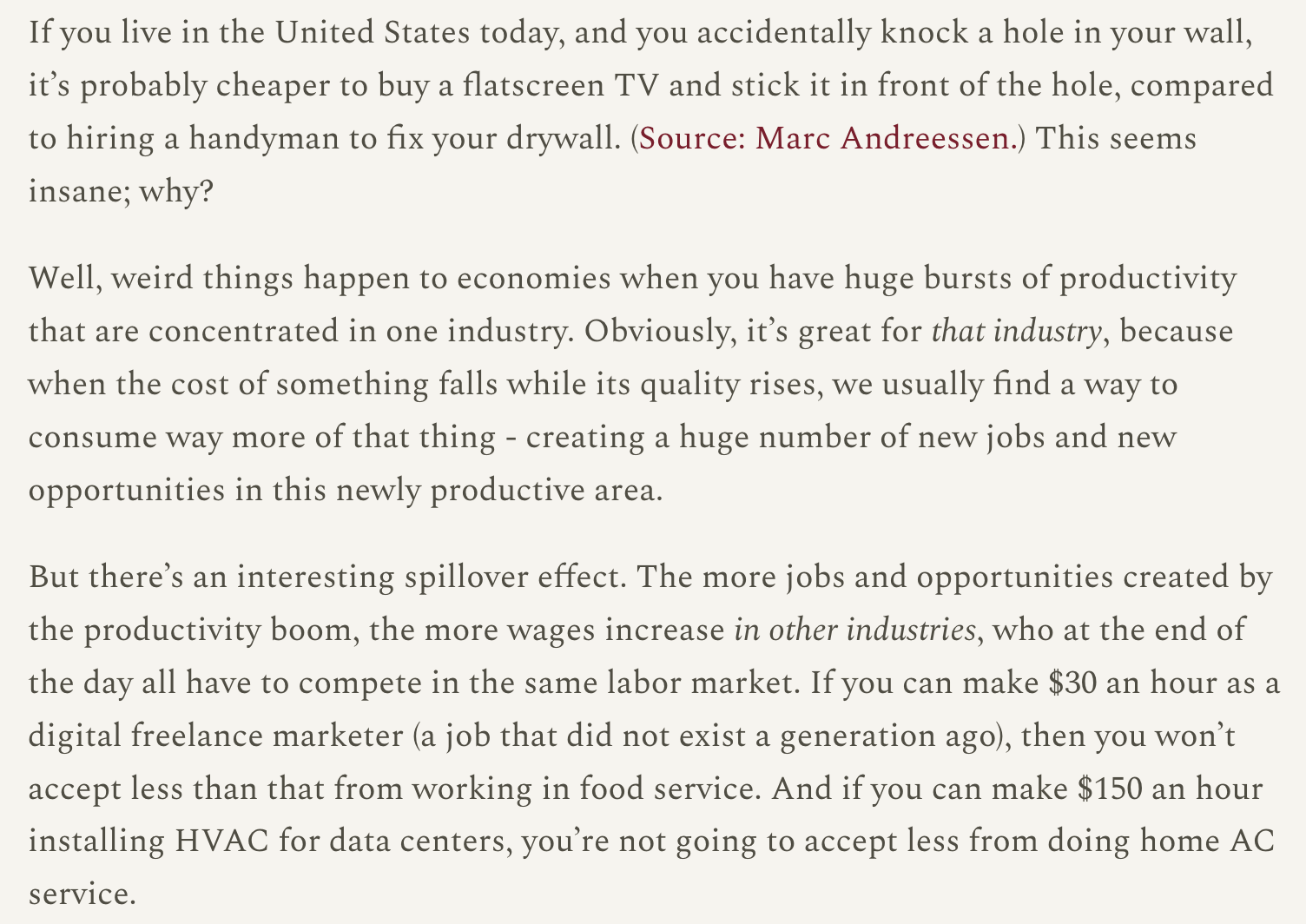
We’re talking about productivity gains and labor costs; AI is about to push both in dramatic directions. The essay hints that the second-order effects might catch us off guard, although they won’t be completely unpredictable.
🎧 How Elon Works
One book I’ve been wanting to read, but never found the time or energy for, is Walter Isaacson’s biography of Elon Musk. The combination of Isaacson’s writing and Musk’s wild life promises ideas and details worth diving into.
David Senra covered the book on his Founders podcast, pulling out the lessons he found after reading and rereading it. The 90-minute episode is a solid listen if you vibe with David’s storytelling style. I didn’t want to miss the stories, so I stuck with it.
If you prefer something quicker, he also shared a thread that captures the key lessons in a crisp way.
For the record; here’s the magic formula that keeps Elon’s teams moving: “The Algorithm.”
9. Apply The Algorithm constantly. (1) Question every requirement. (2) Delete any part of the process you can. (3) Simplify and optimize. (4) Accelerate cycle time. (5) Automate.
🪳 Cockroaches in the Coal Mine
This one comes from Howard Marks, co-chairman of Oaktree Capital. His memos have popped up in my feed a few times, but I never really paid attention. This one stood out because of the title Cockroaches in the Coal Mine, and the metaphor pulled me in right away.
Jamie Dimon, Chairman and Chief Executive Officer of JP Morgan Chase, whose comments are always insightful and direct, said the following last month with regard to the bankruptcy filings from First Brands, an auto parts supplier, and Tricolor, a seller of and subprime lender against used cars: “My antenna goes up when things like that happen. And I probably shouldn’t say this, but when you see one cockroach, there are probably more . . . everyone should be forewarned on this one.”
And we all know that coal miners used to bring along a canary when they entered a mine, since its tiny body would succumb to any gas that was present before the gas could pose a threat to the miners. Both the cockroach and the canary can be precursors of problems ahead. We’ve heard both sayings in use in the last month, and we’re likely to hear them more.
Sub-investment-grade credit isn’t the most thrilling topic to explore, but this snippet, and the clear explanation that follows it, kept even a non-enthusiast reading till the end.
I’ve subscribed to his memos now, so expect more gems from his desk in the coming weeks.
☑️ Seven Decisions
Michael Lopp lists seven types of decisions you see in almost any situation. How someone chooses one isn’t always clear, but his breakdown makes it easier to understand.
Vanilla, Educated, Calculated, Instinct and Inspired make up the first five. It’s the last two that stood out for me.
Minimum Viable. My least favorite. Your investigation into their justification reveals that they chose a decision that was not designed to be good; it was constructed to offend the fewest humans. This is not leadership — it’s fear.
Delegated. Rather than doing the minimal work of even making a minimum viable decision, they gave the decision to someone else because — and I quote — “They are more capable of making this decision.” What they are actually saying is, “I would prefer that this human deal with the weight and consequences for this decision.” The good news: at least you got a decision.
It’s a quick read, but it gives you solid food for thought about your own operating and leadership style.
🛣️ Our Cities Need Wider Roads
I debated adding this one to today’s curation. I’m tired of talking about the traffic mess and everyday infrastructure pain. And there’s still no real solution in sight.
But this Works in Progress piece – Why the developing world needs wider streets – stood out. It doesn’t offer false promises or quick fixes. It simply explains how cities actually work.
Cities enable cooperation. They allow people to specialize, to hire and be hired, to learn from one another, to build things together that none could build alone. Economists refer to the productivity gains that arise from human proximity as agglomeration effects.
The agglomeration effects of cities arise from two things: the physical proximity of buildings to one another, and the intra-city transport system that allows people to move swiftly between them. Buildings without transport are as useless as transport without buildings: the benefits of agglomeration depend on access, on the ability of people and goods to move efficiently across urban space.
This fundamentals-first explanation worked for me. It breaks the problem down to its core pieces, and it nudges us toward real solutions. No shortcuts. No magical fixes.
Our cities need this kind of thinking. I only hope the people in power understand it and use it when they make decisions.
🧠 AI and Infinite Memory
To grow, we must forget… but now AI remembers everything. Amy Chivavibul warns that this infinite memory could change how we think, grow, and imagine.
In a world where hyper-personalization is sold as AI’s gift to humanity, this take feels pessimistic at first, maybe even misplaced. I paused before reading, wondering if I’d fallen for a catchy headline.
I’m glad I clicked. The piece offers a sharp new perspective, one you can dig into and use to shape a stronger point of view.
It’s meant for mental stimulation, in case you’re up for it.
✨ Everything else
London’s thieves are burying phones in flowerbeds. An unexpected treasure of a story, and an equally delightful newsletter.
As the folks at Storythings say, if you want to get good at storyfinding, start with a question you don’t know the answer to, then share what you discover.
As Kottke says, Bill Wurtz’s History of Japan is the most entertaining history of anything I have ever seen. I’ve not seen any other, but I can vouch that this one is super fun.
Registani Ladkiyan: Cute and touching. With their curious observations, Aavya and Rohan will make you pause and think in every post.
ICYMI, here is the link to last week’s post:

Andrew Chen’s Braindump on Viral Loops is my favorite pick. I highly recommend this one to anyone working in product growth areas.
That’s all for this week, folks!
I hope I’ve earned the privilege of your time.
See you next Monday.