
#231 Sufficient Decentralization for Social Networks, Cultural Festivals, Moscow, Ice Cream Trucks, Make “Aha Moments” Click
Jerk Sherlock, Preserving Life’s Work, Guide World, Sew Far Sew Good & more

Hello,
Last week disappeared before I knew it. Karaikudi was stunning, Kodaikanal did great with its weather, and Madurai ended up being a stopover with some fun activity sprinkled in. The trip brought a mix of new learnings about travel and my own preference. I’ve got plenty of photos and stories from it all; I will share them soon.
Before I went, I was chatting with Dharam about the different roles a podcast host plays in a conversation. Here’s the crux of what I’ve noticed after listening to many shows and following some of them closely.
The Challenger: Short, sharp questions. Pushes back, never lets the guest get away with fluff. Example: Tyler Cowen.
The Student with a Map: Learns out loud, adds his own framing, and asks pointed questions to fill gaps. Example: Sarthak Ahuja.
The Relentless Beginner: Asks simple, childlike questions again and again until it’s crystal clear. Example: Nikhil Kamath.
The Curious Explorer: Wide knowledge base, eager to learn, adds variety and sometimes her own ideas to the mix. Example: Shruti Rajagopalan.
The Deep Diver: Picks one or two big ideas and follows them all the way, even if other threads fall off. Example: Mukesh Bansal.
This is, of course, just what I could recall in that moment. It’s based on my personal listening, and since I pick and choose episodes, expect some bias and oversimplification. Still, it’s clear that each host brings a distinct style that shapes the entire conversation.
Have you seen similar patterns? Just by the host’s style, which one works best for you and why? I’d love to expand on this idea and turn it into something useful for anyone thinking of starting a podcast or talk show. Join and help me with your inputs & critiques.
On to today’s finds. Here’s a quick peek at what’s waiting for you.
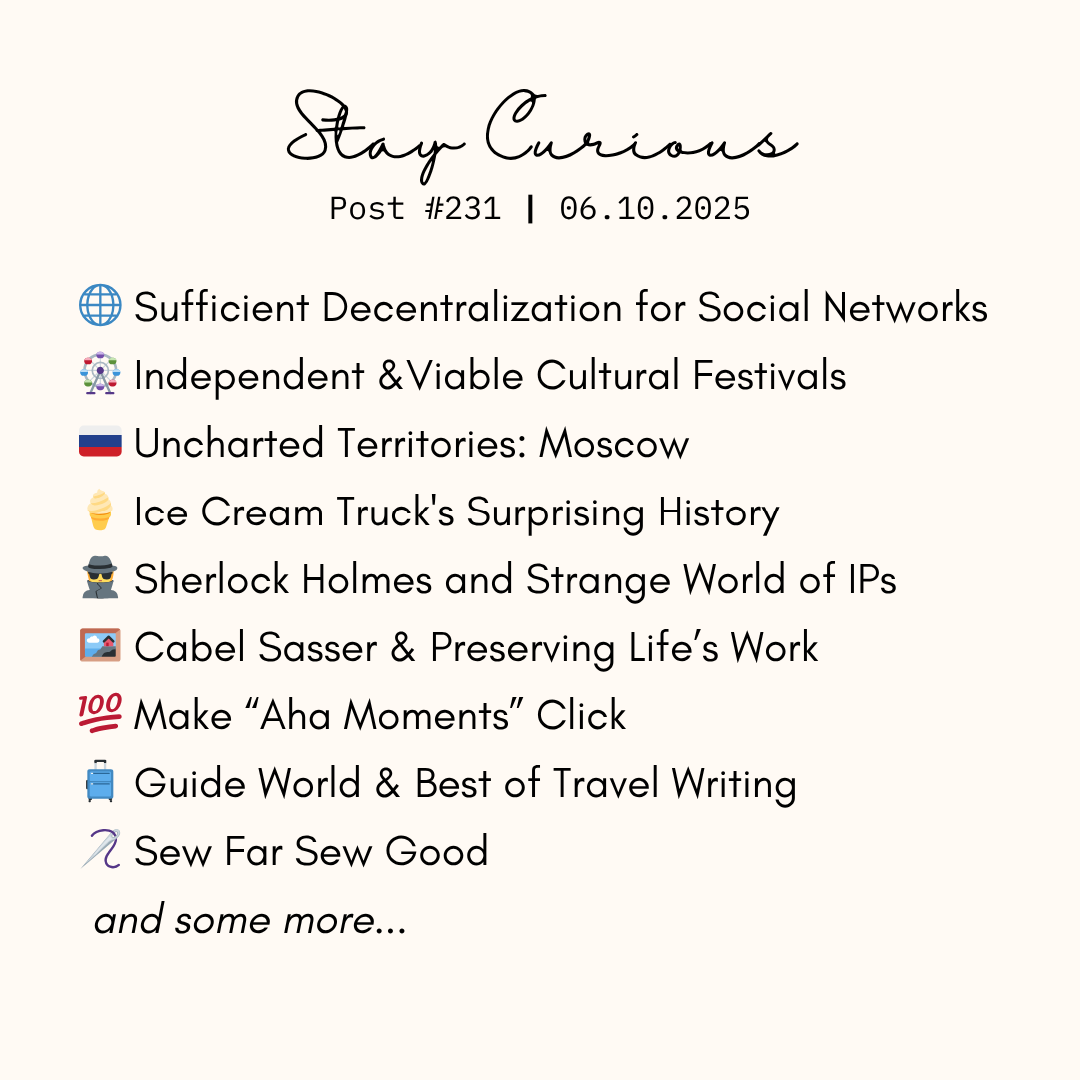
I’ve handpicked these with care. Hope they spark your curiosity as much as they did mine.
🌐 Sufficient Decentralization for Social Networks
Facebook, Twitter, LinkedIn — and the rest of our generation’s social networks — have shaped how we connect, share, and build our digital selves. Over time, we’ve lived through the full cycle: from open access and freedom to limited reach and heavy-handed control by the platforms themselves. Every now and then, the idea of a decentralized social network resurfaces. Many have tried, a few have found small wins, but none have matched the scale or stickiness of centralized giants like Facebook and X.
Varun Srinivasan’s essay Sufficient Decentralization for Social Networks explores a middle path: “sufficient decentralization” instead of full decentralization. He walks through what it really means to build a social network from the ground up, showing how each core function and design choice fuels the massive systems we use today.
A social network achieves sufficient decentralization if two users can find each other and communicate, even if the rest of the network wants to prevent it. This implies that users can always reach their audience, which can only be true if developers can build many clients on the network. If only one client existed, it could stop users from communicating. Achieving this only requires three decentralized features: the ability to claim a unique username, post messages under that name, and read messages from any valid name.
It’s a sharp, compact read that simplifies a complex system into clean, understandable layers. I was hooked by his examples and clarity. If you’re curious about how great system design can untangle complexity, this one’s a gem. Anyone who can think and build at that level is well-equipped to tackle problems that often seem impossible.
🎡 How to Make Cultural Festivals Independent, Inclusive & Sustainable
Cultural festivals thrive when they put community before commerce and independence before sponsorship—while constantly experimenting to stay relevant and inclusive.
In this Founding Fuel special, V Ravichandar and Shivendra Singh Dungarpur share their lessons on building cultural festivals that are independent, inclusive, and sustainable.
Ravichandar has been deeply involved in four key projects—Bangalore Literature Festival, BLR Hubba, Bangalore International Centre (BIC), and Sabha. If you’re from Bangalore or follow its culture scene, you’ll recognize these as defining symbols of the city’s creative and civic energy.
Dungarpur, through the Film Heritage Foundation, has been working tirelessly to restore India’s cinematic legacy and now leads the Mumbai MAMI Film Festival, bringing the same passion for preservation and storytelling to a broader stage.
This conversation is packed with insights and practical ideas to help you create your own mini version of such cultural events. If these themes interest you, I highly recommend the full one-hour discussion. There’s also a handy summary that captures the key takeaways for a quick read.
For me, cultural events that bring people together—and public spaces that allow such connections to happen naturally—are what make a city truly alive. It’s a theme close to my heart, and I always find it inspiring to learn from those who build and nurture such spaces.
🇷🇺 Uncharted Territories: Moscow
Moscow is the biggest city in Europe. How come?
It’s one of the northernmost capitals in the world, yet away from the warming influence of the sea. Why?
Most European capitals are on a major river, but Moscow is on a tributary of a tributary of a river that ends in a lake. And while most other big cities are on river confluences, Moscow isn’t. Why such a poor location?
[...]
How did Moscow evolve from a swampy village in the 1100s to the biggest European city with over 20M people?
The answer to all these questions is pretty crazy. It involves horse archers, human harvesting, and tiny animals, and it tells us a lot about Russia’s past and its future.
Well, that’s the premise of Tomas Pueyo’s Why Is Moscow So Weird?. I don’t need to share anything more.
If it’s from Uncharted Territories and free to read, you have no reason to skip this one. Expect captivating storytelling, stunning graphics, and a masterful discourse on geopolitics and culture.
Go read it; you can thank me later.
🍦 Ice Cream Truck’s Surprising History
Today when I hear ‘ice cream truck,’ I picture those bright vans from movies or the fancy food trucks that pop up at city hotspots. But growing up, we had our own version of them. Ice-cream carts would roll through our lanes, kulfi and ice-gola stalls parked by the chowpatty, and vendors on cycles serving at tourist spots. We didn’t miss out—we just had it simpler and closer to home.
Olivia Potts’ Longreads piece The Ice Cream Truck’s Surprising History takes a delightful spin through the evolution of ice-cream trucks around the world. It’s packed with gems—old-school flavors, Italian hokey-pokey sellers, truck chimes, penny licks, turf wars, murder mysteries, and even how auto innovation and TikTok trends shaped the business.
In the UK, the most popular ice cream truck product is a 99: a classic soft serve vanilla ice cream served in a wafer or waffle cone, with—crucially—a “99 chocolate Flake” stuck on top, from which the confection gets its name. The 99 Flake, a favorite since the ’30s, is a half-length of a Cadbury Flake chocolate bar. Made of layers of rippled chocolate without a coating, it scatters chocolate shards with every bite and is transportingly delicious. Sadly, this treat has not made it across the pond, but it is such an integral part of the British ice cream van experience that Flake shortages in 2021 were attributed to high ice cream demand due to good weather.
Today, the truck itself is as iconic as the ice cream it serves. Despite its boxy aesthetic, there’s something aspirational about it. While filming the Harry Potter movies, Rupert Grint, who played Ron, bought a 1974 Bedford Mr. Whippy van, fulfilling his childhood dream of becoming an ice cream man. (He learned the van’s appeal the hard way: A bunch of local kids tried to buy 99s from him while he was performing a U-turn in a pub carpark. Now he stocks the van and gives ice cream and lollies away for free.)
The world seems ready for a nostalgic comeback, with vintage-style ice-cream trucks making their way back. Reading this made me crave a scoop of my favorite flavor right away.
Oh, and this isn’t my first trip down the ice-cream truck lane. Dan Heath had done a fantastic episode on What It’s Like To Be… An Ice Cream Truck Driver. Go listen, it’s fabulous.
🕵️ Sherlock Holmes and Strange World of IPs
Why was Sherlock such a jerk?
As Dan Lewis explains in Sherlock Holmes and the Case of Being Too Nice, the answer lies in how IP protection shaped what we see on screen and in print.
The original Sherlock, written by Arthur Conan Doyle, started out as a brilliant yet emotionally detached detective. Over time, Doyle softened him — making him more empathetic, kind, and even gentle. But here’s where it gets interesting: due to IP laws and the risk of violating protected material from later stories, creators often avoided portraying this evolved version. The result? Most adaptations stuck with the colder, sharper Sherlock we all recognize.
It’s a fascinating case of how legal constraints can shape cultural memory.
I wouldn’t be surprised if IP lawyers now use this as a classroom case study — it’s a classic, and elementary.
Also, if you haven’t yet, check out Dan Lewis’s weekly newsletter Now I Know. It’s full of curious stories like this — smart, surprising, and always fun to read.
🖼️ Cabel Sasser & Preserving Life’s Work
Cabel Sasser’s work and ideas have made a few appearances in this newsletter. In #98, we explored the playful design details of the Playdate console. In #118, we saw what he means when good design makes fantasy meet reality. I’ve always admired his obsession with detail and the deep love he brings to his craft.
So when I stumbled upon his 2024 talk at XOXO Festival, I had to watch it. It starts with a quick recap of his journey with Panic and Playdate; but that’s not the reason you should see it. The real magic begins when he talks about discovering a stunning McDonald’s mural in Centralia, and the life of its little-known creator, Wes Cook.
There’s something powerful about honoring someone’s life’s work, especially when done with Sasser’s trademark energy and heart. His storytelling is electric; the kind that makes you wish you were in the room, soaking it all in.
I absolutely loved it.
✨ Everything else
Long-time readers will know Growth.Design and their brilliant UX case studies that turn design lessons into fun, visual stories. His latest one — 3 UX Tips To Make “Aha Moments” Click — is spot on, as always. I especially liked the bit about “Too Good To Go”. The problem they’re solving is real, and I hope they’re getting good traction in reducing food waste.
When Patrick Collison puts out a new list, it’s worth your time. His latest, Guide World, is a curated set of great reads on travel writing. I always check Sam Mendelsohn’s blog before heading anywhere in India. It’s my go-to for stories, tips, and hidden gems. Hats off to folks like Sam who make travel not just easier, but a lot more fun.
Danielle Clough is an embroiderer from South Africa. Her needle work is unlike you’ve seen every - so vibrant, rich and alive.
ICYMI, here is the link to last week’s post.

It generated a bunch of conversations, I loved those. Keep them coming.
That’s all for this week, folks!
I hope I’ve earned the privilege of your time.
See you next Monday.
Love the compilation that you put together week after week Pritesh. Not sure where you might bucket Neil Degrasse Tyson’s style of conducting the Startalk podcast.
And, about Moscow, read up a bit and how fascinating! And I had heard Dan Heath’s podcast What’s it like to be and loved the episode around the ice cream truck. Yet to go through the other articles in this week’s package but will go through at leisure!